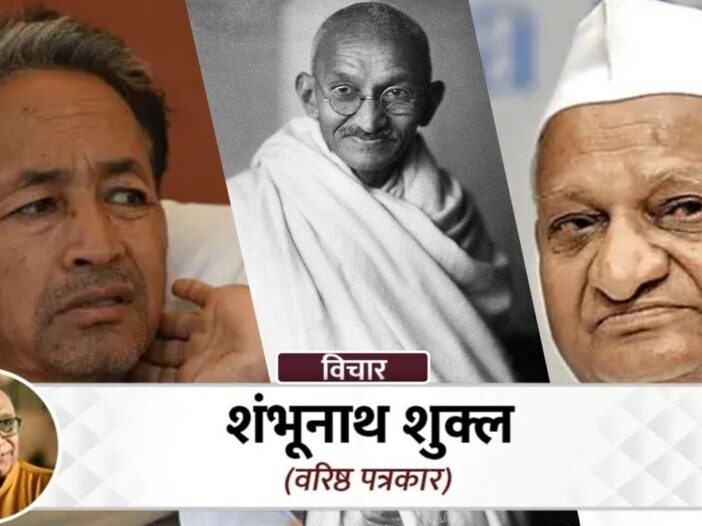
Hunger strike is a tradition of getting one’s demands met by often inflicting pain on oneself. It started in Ireland, where prisoners used to go on hunger strikes to get their demands met. Later, Gandhiji started it in India’s independence movement. This is a kind of non-violent resistance, which is done against the arbitrariness of power. Revolutionaries Bhagat Singh, Batukeshwar Dutt and Jatindra Nath Das fasted while in jail. His demand was that he should be given the status of political prisoner in jail.
Jatindra Das died on the 68th day of this fast. In a way, this is both spiritual contemplation and an attempt at self-purification. Stories of fasting are also present in ancient Indian philosophies. Traditions of sacrificing one’s life by sacrificing food and water are found in stories. Santhara is reality in Jain philosophy.
Gandhiji made political use of fasting
But Mahatma Gandhi made political use of hunger strike. He first went on a seven-day hunger strike in 1913 in Phoenix (South Africa). He called it a penance (self-purification) fast. He observed two more fasts in Phoenix. In February 1914, Gandhiji fasted over the theft of some fruits in the ashram. The very next day the person who violated the rules of the ashram confessed to his crime. This fast is over.
In the same year he observed another penitential fast of 14 days. But his three-day fast in 1918 became a topic of political discussion. Actually the textile mill workers of Ahmedabad were on strike for their demands. The owner was also adamant. But after Gandhiji’s fast both the parties agreed.
Fast became a weapon against violence
Gandhiji used to fast against every effort that would lead to the path of violence. In April 1919, when an attempt was made to derail the train in Nadiad, he fasted for 72 hours. After this, when violence broke out during the arrival of the Prince of Wales in Bombay in 1921, he announced an indefinite hunger strike. The situation became normal within three days. In 1922, he went on a fast in protest against the Chauri-Chaura incident, which lasted for five days. To strengthen Hindu-Muslim unity, he fasted for 21 days in 1924. His most famous fast took place in 1938, when he fasted for 21 days in protest against untouchability. Later, Gandhiji would go on a fast unto death to get what he believed to be right.
Gandhiji also fasted a few days before the assassination
This was the period when Gandhiji was the most influential and popular leader of the country. He did not hold any position in Congress but no one had the courage to reject his views. His last fast took place a week before his death in 1948, when he protested against the destruction of Delhi’s mosques during the partition riots. Gandhiji was the first person who understood the true meaning of fast and used it at the right place. The British government also bowed under the pressure of his fast.
In 1932, he fasted from Yerwada jail in protest against the Communal Award. In this way Gandhiji used fasting as a means to protest against injustice. Gandhiji used the same weapon against the British rule and also to restrain the anger of his people from turning violent. That is why Gandhiji was called Mahatma.
Public sympathy on hunger strike
After him, countless people used fasting as a weapon to fight the evils of power and society. In a way, this weapon of war came to India through Gandhiji. The hunger strike took on its divine form by becoming engrained in Indian values. Here it was called fast i.e. civil disobedience movement. It proved to be very lethal and global. In the name of humanity, you use such a weapon, due to which your demand takes a political form.
Many times the government comes to a standstill and bows down because there is so much pressure from the public that no government is able to bear it. In democracy the people are supreme. But despite this, many times those fasting had to lose their lives. With time, people and his supporters also forgot him. Therefore, the one who wins the fast gets victory.
Sriramulu and Darshan Singh Pheruman lost their lives
In 1952, Potti Sriramulu demanded separation of Andhra Pradesh. But Prime Minister Jawaharlal Nehru was not ready for this. Sriramulu remained on fast to get his demands fulfilled. Ultimately he died on the 58th day of his fast. His hunger strike and demands were fulfilled and Andhra Pradesh became a new state on October 1, 1953.
On November 1, 1966, Haryana was formed as a separate state by dividing Punjab. But Akali leaders believed that many Punjabi speaking areas had been given to Haryana and against this, Akali leader Sant Fateh Singh started a fast unto death on 17 December 1966. He said that if his demands were not met, he would commit suicide. When the then Prime Minister Indira Gandhi herself asked him to mediate, Sant Fateh Singh broke his fast.
When no action was taken from the Prime Minister, another Akali leader Darshan Singh Pheruman started a fast from August 1969. When he was arrested on 12 August, he went on a fast in jail from 15 August 1969. Due to deteriorating health, he was admitted to the hospital on 27 August but he did not break his vow. He died on 27 October 1969, on the 74th day of his fast. But his demand could not be fulfilled because Udayveer Singh Mann had announced a fast unto death against him in Haryana. However, the Central Government had agreed to give Chandigarh to Punjab.
Irom Chanu Sharmila fasted for 16 years
Apart from this, Manipur’s social activist Irom Chanu Sharmila fasted for almost 16 years. His fast continued from 5 November 2000 to 9 August 2016.
From Anna Hazare to Wangchuk
Anna Hazare started a fast at Jantar Mantar in Delhi to bring Lokpal Bill. Anna Hazare fasted for a total of 13 days from 16 August 2011 to 28 August. Later the Central Government brought the Lokpal Bill in 2013. Environmentalist Professor GD Aggarwal fasted for 111 days regarding the purification of Ganga and died on the 111th day. Professor Aggarwal had retired and his new name was Swami Gyan Sanand.
Social activist Sonam Wangchuk sat on a fast unto death against the irregularities in the Medical Entrance Examination (NEET) 2026. But on the night of 16 August 2026, he was picked up from Jantar Mantar and admitted to the hospital. His health was continuously deteriorating. Wangchuk Cockroach was on hunger strike to support the Janata Party’s demand for an investigation into the irregularities in NEET.

Leave a Reply