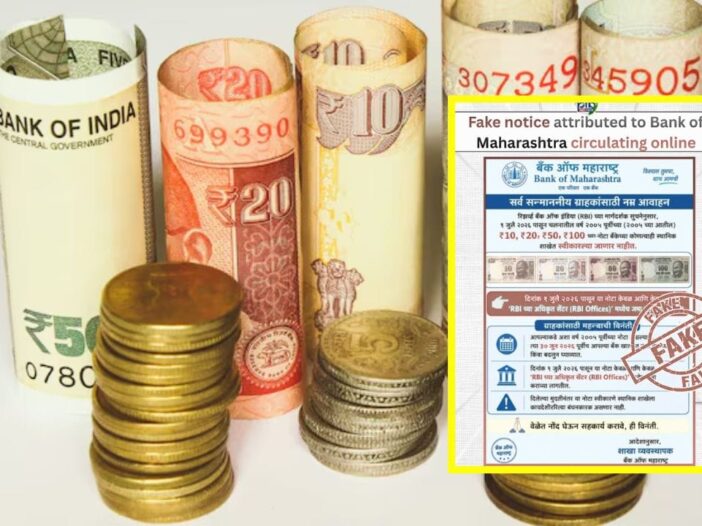
For the past few days, a news has been spreading rapidly on social media and WhatsApp groups, which has increased the concern of small businessmen as well as the common man. It is being claimed that from July 1, 2026, old notes of Rs 10, 20, 50 and 100 will become invalid for transactions in the market. This news suddenly put people in fear of a possible ‘silent demonetisation’. But, if you have these old notes lying around in your house or shop, then you do not need to worry at all. This claim has been proven to be completely baseless and false. Along with the government’s fact checking body PIB, Bank of Maharashtra has also officially made it clear that no such new rule is going to be implemented. All the notes you have will remain completely valid as before.
Reality of fake order spread on social media
The impact of rumors in the financial market is very rapid. The latest controversy started when a purported circular resembling Bank of Maharashtra letterhead went viral on the internet. In this fake notice, it was claimed that under the strict instructions of the Reserve Bank of India (RBI), notes of Rs 10, 20, 50 and 100 printed before the year 2005 will not be accepted in any branch after June 30, 2026. This news has put into dilemma many people and small traders who depend on these small denomination notes in their daily sales.
As soon as the rumor gained momentum, Bank of Maharashtra immediately intervened. Issuing a clarification on its official Facebook page, the bank said that no such order or circular was ever issued by them. The bank has strongly appealed to the customers not to trust such misleading messages.
Don’t fall for fake news!
A notice allegedly issued by Bank of Maharashtra is being shared online, falsely stating that, as per RBI directives, ₹10, ₹20, ₹50, and ₹100 banknotes printed before 2005 will not be accepted from July 1, 2026.#PIBFactCheck: :
This claim is https://t.co/mF7fdyQWvm
— PIB India (@PIB_India) June 27, 2026
Reality revealed in PIB investigation
Preventing misinformation is a big challenge in the digital age. PIB (Press Information Bureau), the agency that checks the authenticity of government policies and announcements, also took cognizance of this viral matter. PIB Fact Check team thoroughly investigated this alleged notice and declared it completely fake. The official statement clearly states that the general public should avoid falling prey to such rumors related to the economy. For any important financial decision or information, only official websites should be trusted.
Reserve Bank’s rule on old notes
Amidst this entire controversy, it is very important to understand what is the real stand of the Reserve Bank regarding old currency notes. In fact, under a banking instruction issued in the year 2015, RBI had definitely stated that the circulation of Mahatma Gandhi Series notes printed before 2005 has remained very less in the market. Due to this, the Central Bank had given the facility to the general public that if they have such old notes left, they can exchange them at any time by going to their nearest banks.
However, at the same time the Reserve Bank had made it very clear that all these old notes will remain completely legal tender. The main objective of the bank behind printing new currency was only to reduce the increasing threat of fake notes, because the new notes have more advanced security features to avoid counterfeiting. RBI has never issued any order to ban these small old notes.
Misinformation spread without thinking in financial matters often weighs heavily on the mental peace of the common man. Be alert as a conscious citizen. The old notes of Rs 10, 20, 50 or 100 that you have are completely safe.

Leave a Reply