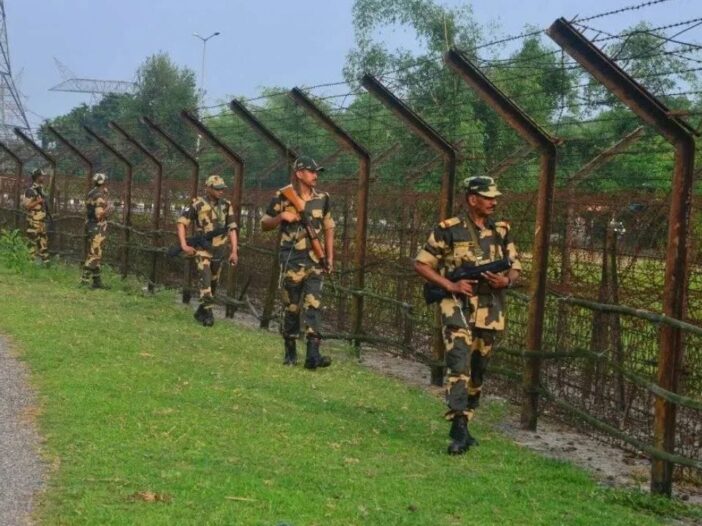
A major step has been taken to make the security on the international border of India and Bangladesh impenetrable. The Border Security Force (BSF) has started fencing work on war footing in those sensitive and open patches of the India-Bangladesh border adjacent to West Bengal, which had remained a major security challenge for years.
After the recent political changes in the state and formation of the new BJP government, the land acquisition cases pending for the last several years have gained momentum. Showing promptness, the state government has speeded up the process of handing over the land to BSF for fencing.
Survey of land with local people
Senior BSF officials visited strategically important areas like ‘Chakrabanda’ of North 24 Parganas and other border districts. During this, the officials along with the local villagers and administration took a joint survey of the land.
A senior BSF officer told the media, “The process of handing over the land is now going on very smoothly. Soon, the land of many other patches, including a large and highly sensitive part of about 27 kilometers long, will also be handed over to the BSF. The cooperation being received from the administration and the local people is proving helpful in completing this work quickly.”
Why is this fencing important?
The total length of the India-Bangladesh border is 2,216 kilometers, out of which about 569 kilometers has not been fenced yet. Due to this open area, incidents like infiltration, cattle smuggling, fake currency and drug smuggling keep happening and this open border route remains the main challenge for BSF and security forces.
This 569 km open stretch includes riverine borders, dense residential areas and cultivable lands, taking advantage of which anti-social elements could easily cross the border.
Crimes will be curbed, local people welcomed
According to BSF, with the completion of this fencing, not only infiltration and human smuggling on the border will be completely stopped, but smuggling of cattle and prohibited goods will also be effectively controlled. Along with state-of-the-art fencing, smart fencing system equipped with flood lights, anti-cut sensors and night-vision cameras is also being installed in this entire corridor.
Technical monitoring will also be strengthened
According to sources, in areas where it is not possible to install physical fence due to presence of river or marshy land, ‘Technical Fence’ (Comprehensive Integrated Border Management System – CIBMS) is being used. It includes underwater sensors and thermal imagers, so that there is not even an inch of ‘blind spot’ in the surveillance system.
Due to better coordination between the Union Home Ministry and the State Government, it is believed that the first phase of this mission will be completed within the next few months, due to which the eastern border of the country will be completely secured.

Leave a Reply