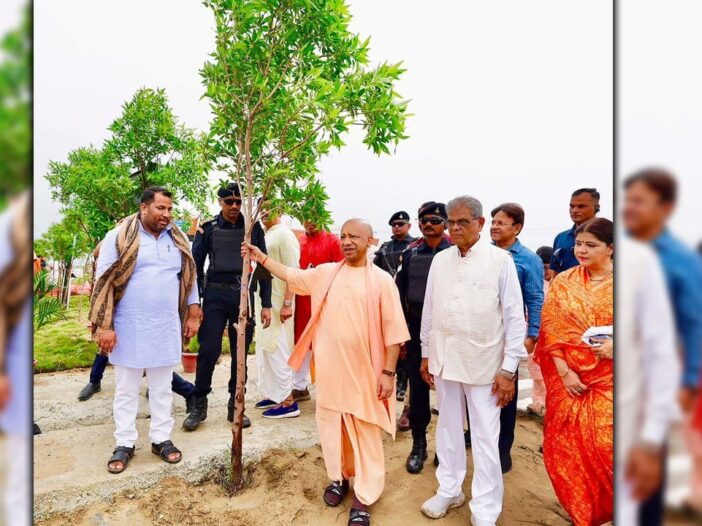
In the Indian tradition of thought it is said – Vrikso Rakshati Rakshatah. That is, if we protect the trees, they protect us. There can hardly be a more meaningful message between nature and man than this that if you save trees, they will save you. This is also the eternal truth and this formula has propounded the unbreakable relationship between man and nature since the beginning of civilization. Forests gave us shade, rivers developed civilization and we found the basic elements of life in the roots of trees.
But the race for modern development has blinded us so much that we forget that we have a responsibility towards the nature that gives us life. At a time when climate change poses a global challenge, Chief Minister Yogi Adityanath Under the leadership of Uttar Pradesh, Uttar Pradesh has set an example for the entire country which is not only a wonderful example of administrative efficiency but also a wonderful expression of gratitude towards nature.
More than 35 crore saplings were planted in one day
Uttar Pradesh has made a record of planting more than 35 crore saplings in a single day on 12th July. This is not only astonishing, but the preparation, coordination and huge determination of the Yogi government is also visible behind it. Clear vision and determination of leadership also comes to the fore. Only when this happens can impossible goals be realized.
If we look deeply, the environmental thinking of Chief Minister Yogi Adityanath is visible in the soul of this entire campaign. He has always believed that development and environment protection are complementary to each other and this vision of his became the basis of the forest policy of Uttar Pradesh, which achieved this historic achievement of tree plantation with the amazing combination of administrative capacity, visionary thinking and public participation.
Sudhir Kumar, Editor, Wildlife Today
CM Yogi has termed the plantation as Mahayagya. This also has implications in Indian tradition. Yagya means sacrifice, dedication and determined work done for collective welfare. When we plant a tree, we do not expect any reward for ourselves, but invest in shade, clean air and water conservation for future generations.
Nature is godlike in Sanatan culture
In our Sanatan culture, trees are like gods, rivers are mothers, mountains are revered because our sages had a deep scientific and spiritual understanding of co-existence with nature. In the last nine years, the UP government has worked to give life to this co-existence by planting crores of saplings and also to revive the cultural heritage in which gratitude towards nature was the central element of the philosophy of life.
In a large and densely populated state like Uttar Pradesh, where the pace of industrialization and urbanization is rapid, increasing the green cover is a challenging task. But this challenge makes this achievement even more remarkable. Since 2017, more than 280 crore saplings have been planted in the state. Due to this, a historic increase of about three lakh 80 thousand acres has been recorded in the tree cover of the state.
Reshaping geography, climate and ecology
This is evidence of a change that is gradually reshaping the geography, climate and ecosystem of the state. The appearance of greenery in barren lands and the rising groundwater level are proof that when a policy is implemented consistently, its impact becomes cumulative over time and becomes huge.
Trees don’t just provide shade or fruit, they bind soil, balance groundwater levels, help stabilize the climate by absorbing carbon dioxide from the atmosphere, and provide food and shelter to countless animals and creatures.
In this series, it is also necessary to mention the campaign in the name of a tree mother. This campaign has given an emotional dimension to tree planting. Indian thinking gives the status of mother to the land. It is said in the Vedas – Mata Bhumiah Putroham Prithivyaah, that is, the Earth is my mother and I am her son. This is a philosophy of life which equates the relationship between man and nature to the unbreakable relationship between mother and son.
When a person plants a tree in the name of his mother, he is actually expressing his gratitude to both these mothers – the birth mother and Mother Earth simultaneously. It is this emotional connection that elevates this campaign above a government program and connects it to the hearts of the people.
Increased danger from air pollution
Extensive plantation will have multidimensional impact on human life. Increasing air pollution has today become the main cause of respiratory diseases in urban and semi-urban areas. Increase in green cover will improve air quality, providing clean air to people. Improvement in groundwater level will reduce the severity of water crisis in the coming years.
The presence of trees increases soil fertility and keeps the local climate balanced. This will have a qualitative impact on the crops of the farmers. There is additional benefit of direct and indirect employment to thousands of people in works related to nursery industry, forest products and tree care. But, the most profound impact will probably be seen at the social and psychological level.
When millions of citizens plant trees in the soil with their own hands for a common goal, a sense of personal connection and responsibility towards nature is born. This feeling becomes a thought, a ritual in the lifestyle. Children naturally become citizens sensitive towards environmental protection.
Regular irrigation of plants is also necessary
But the duty is not fulfilled just by planting trees. The true success of plantation lies in the survival of those plants and their growth into trees. Planting a tree is the beginning, not the end. After this, only irrigation, protection, care and constant monitoring will decide whether the crores of saplings planted today will turn into dense forests tomorrow or not.
Yogi government’s thinking is serious in this direction too, but the society will also have to understand its responsibilities. It is important that every gram panchayat and every institution accepts this as its long-term responsibility. Every citizen should associate his happiness with the growth of plants into trees like his children.
The most meaningful expression of gratitude
Planting trees is the most meaningful expression of our gratitude towards nature. Just as a child tries to repay the debt for the kindness of his parents, similarly man should also repay the debt to the earth which has given him life, food, water and air. Every sapling planted today will become a tree tomorrow and will enrich the environment.
It will also remind that when the resolve is strong and the leadership is clear, collective efforts can make even the impossible possible. Rabindranath Tagore had written that trees are the continuous effort of the earth, which communicates with the sky. This dialogue is not only of nature but also of generations. (These are the personal views of the author.)

Leave a Reply