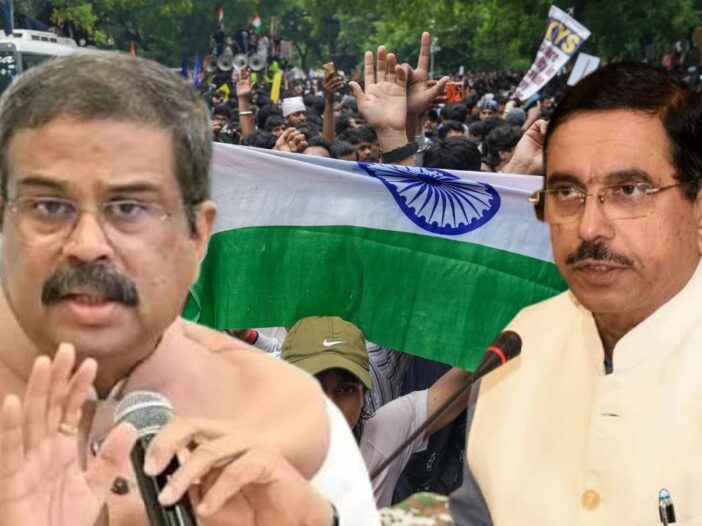
There were several major developments on Saturday in the NEET paper leak controversy, starting with the resignation of Union Education Minister Dharmendra Pradhan after weeks of protests across the country. A few hours later, Pralhad Joshi was made the new Education Minister, with additional responsibilities of New and Renewable Energy and Consumer Affairs, Food and Public Distribution.
Earlier the center and Cockroach Janata Party (CJP) A third round of talks took place, after which the government agreed to withdraw the FIR registered against the peaceful protesters. After the talks, the CJP announced immediate withdrawal of their 36-day agitation at Jantar Mantar, and said they were ending the protest in “good faith” after the government accepted their main demands.
At the same time, the government promised to bring a bill to stop paper leaks. On Monday, Union Minister Jitendra Singh will present the amendment bill in the Lok Sabha to stop paper leaks.
This development was the biggest political fallout of the NEET controversy, leading to student protests across the country, a CBI investigation, and major reforms in India’s examination system.
Prahlad Joshi given additional charge of Education Ministry
Hours after Dharmendra Pradhan’s resignation, President Draupadi Murmu, on the advice of Prime Minister Narendra Modi, handed over the additional charge of the Union Education Ministry to senior BJP leader Pralhad Joshi. On being given additional charge of the Education Ministry, Union Minister Prahlad Joshi said, “I accept this responsibility with duty and humility. I am thankful to the Prime Minister.”
He said that many historic achievements have been achieved in the last 12 years of Prime Minister Narendra Modi’s government. In the last four-five years, Dharmendra Pradhan also implemented the National Education Policy, and many important initiatives were taken. The country has made a lot of progress in the new education system. Under the guidance of the Prime Minister, I will work to the best of my ability and fulfill my responsibilities diligently.
Agreement reached between Center and CJP
After the third round of talks, an agreement was reached between the Center and CJP. Hours after Pradhan’s resignation, the third round of talks took place between the Center and the Cockroach Janata Party, after which the CJP announced immediate withdrawal of its 36-day protest. At a joint press conference with Union ministers JP Nadda and Jitendra Singh, CJP spokespersons Ashutosh Ranka and Saurav Das said the agitation was being called off in good faith after the government accepted their main demands.
CJP said that its main demand, Pradhan’s resignation, has been met. It also said that the Center has agreed to withdraw the FIR and legal cases against the peaceful protesters and assured that no retaliatory action will be taken.
The government also agreed to compensate the families of students who commit suicide as per existing rules and laws and promised to consider the CJP’s five-point charter on examination reforms. JP Nadda said that the government has sympathetically considered the demands of the delegation and will further discuss long-term reforms to strengthen the examination system.
Movement at Jantar Mantar ends after 36 days
CJP’s protest started on June 20 at Jantar Mantar, demanding accountability over the alleged NEET-UG paper leak, major reforms in the examination system and resignation of Pradhan.
The movement gained nationwide attention after activist Sonam Wangchuk joined the movement with an indefinite hunger strike. His deteriorating health and subsequent hospitalization attracted people’s attention and increased pressure on the government.
Although Wangchuk ended his 26-day fast after receiving a written assurance from the Centre, the CJP continued its protest until Pradhan resigned and the remaining demands were addressed and ended the agitation after 36 days on Saturday after reaching a compromise with the Centre.
Opposition declared victory of students
The opposition called Pradhan’s resignation a big victory for the students and again raised the demand for major reforms in the education system. Leader of the opposition in the Lok Sabha, Rahul Gandhi, called the resignation a “victory for the future of India” and said that Pradhan has become a symbol of corruption, incompetence and the decline of the country’s education system. He said that the government should now bring true reforms and alleged that the issue of police action against student protestors will also be important in the monsoon session of the Parliament.
Metro stations reopened after protests ended
After CJP ended the 36-day-old protests, normal metro access resumed in Delhi. Delhi Metro Rail Corporation (DMRC) reopened the entry gates of all those stations which were closed due to security arrangements. The metro stations reopened soon after the resignation of Union Education Minister Dharmendra Pradhan and the Center reaching an agreement with the CJP to end the agitation.
Earlier in the day, DMRC had resumed services at Rajiv Chowk, Mandi House and Central Secretariat stations, before restoring entries and exits at the 18 affected stations which were restricted due to protests near Jantar Mantar.
Proposal for strict law against paper leaks
The Center has proposed major changes in the Public Examinations (Prevention of Malpractices) Act to ensure speedy investigation, timely trial and strict punishment for paper leaks and examination malpractices. The proposed bill has provisions for setting up a Special Task Force (STF) to investigate crimes, completing the investigation within two months, daily hearings in special fast-track courts and disposal of appeals by the High Court within three months.
There has also been a significant increase in punishment in this, in which there is a proposal of up to 10 years in jail and a fine of up to Rs 10 crore for organized paper leak racket, along with this, strict action will be taken against the service providers and officials involved in cheating in the examination. Minister Jitendra Singh will present this bill in the Lok Sabha on Monday.
Resignation of Education Minister Pradhan
Dharmendra Pradhan’s resignation is the biggest political fallout of the NEET-UG paper leak controversy, which started after allegations of question paper leak in the May 3 exam. The controversy led to the cancellation of exams, a nationwide CBI investigation, repeated protests, a disruption in Parliament, changes in anti-paper leak laws and a major restructuring of the National Testing Agency.
Read this also- The movement ended on these conditions: CJP’s 5 point charter and government’s retained guarantee.

Leave a Reply