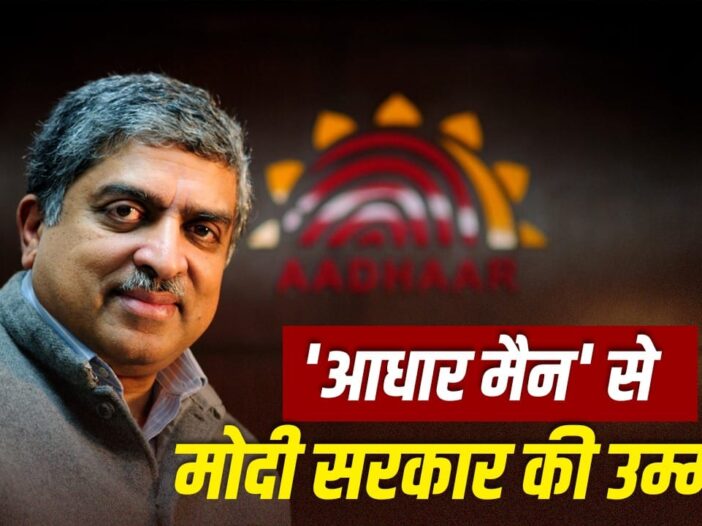
The biggest fear of crores of students preparing for competitive examinations in the country is paper leak. Years of hard work, sleepless nights and hard-earned money of parents come to naught when it is found out that the paper has been leaked. To root out this serious problem, Prime Minister Narendra Modi has formed a high-powered task force. The responsibility of its leadership has been handed over to the country’s well-known technocrat and father of Aadhaar, Nandan Nilekani.
The question arises that why was an IT expert and co-founder of Infosys chosen instead of an educationist or bureaucrat to reform the field of education and examination? The reason behind this decision is Nilekani’s impeccable track record, his amazing ability to implement technology on a large scale and an experiment he conducted in 2017, which made the entire system transparent.

1. Have done miracles in SSC
Nilekani, in the year 2017, the paper of CGL (Combined Graduate Level) exam of Staff Selection Commission (SSC) was leaked, which caused a huge uproar across the country. In 1999, the Supreme Court appointed retired judge G.S. to investigate the case. A committee of 7 members was formed under the chairmanship of Singhvi. Nandan Nilekani was one of the key members of this committee. At that time Nilekani had given some technical suggestions in a closed envelope to make the exam system foolproof. Later the government told in the Rajya Sabha that it had done these 4 major things to stop paper leaks in SSC.
- Widespread Use of CBT (Computer Based Examination): Dependence on paper question papers was reduced and a completely computer-based system was adopted.
- Third-Party IT Audit: To ensure that there are no technical flaws in the examination process, audit by an impartial third-party was made mandatory.
- Encryption and secure delivery: Arrangements were made to digitally encrypt the question papers and send them directly to the exam centers in a secure manner.
- CCTV and CERT-In Audit: Strict CCTV surveillance of the examination centers and security audit by CERT-In, the nodal cyber security agency of the Government of India, was implemented.
Since the implementation of these reforms, SSC has conducted at least 50 major examinations and not a single paper has been leaked.
2. The person who digitalizes identity
Nandan Nilekani, born in Bengaluru in 1955, studied electrical engineering from IIT Bombay. Nilekani, who started his career with Patni Computer Systems, joined N.R. Founded Infosys with Narayana Murthy and five other partners. He was its CEO from 2002 to 2007, during his tenure the company achieved success at the global level.
In 2009, when the then Manmohan Singh government mooted the idea of a National Identity Card scheme to stop subsidy leakage, Nilekani was given the rank of Cabinet Minister and made the Founder Chairman of UIDAI to get this ambitious project off the ground. Nilekani not only created the concept of Aadhaar, but also successfully extended it to more than one billion people. Today 144.9 crore people in the country have Aadhaar. Between 2009 and 2024, the government has saved Rs 3.48 lakh crore through the Aadhaar-linked DBT (Direct Benefit Transfer) scheme.
Deep connection between government and Nilekani
This is not limited to just identity cards, Nilekani’s name is associated with almost every big story of India’s digital transformation.
- UPI Revolution: He played a big role in promoting the UPI framework which made India’s digital payment number one in the world. In 2019, he was the head of the committee related to digital payments of RBI.
- Digital Framework of GST: He was associated with TAGUP (Technical Advisory Group for Unique Projects), which proposed technical reforms in tax administration and paved the way for the GST ecosystem.
- G20 and AI: In January 2023, he was made co-chair of the G20 Task Force (DPI). Recently, he has also been included as an expert in the AI (Artificial Intelligence) Committee of the Supreme Court in 2025. Additionally, he is also the Chief Mentor of the ‘India Energy Stack’ Task Force for the Power Sector.
- In 1999, he led the Bengaluru Agenda Task Force in collaboration with the Congress government in Karnataka, whose objective was to improve urban governance and infrastructure.
Why did Modi government choose Nilekani?
According to sources, there was a consensus within the government that a very complex task like examination reform cannot be solved through old and traditional bureaucratic methods. For this, institutional change is required on a large scale and for such change, an expert is needed who can implement technology on a large scale. Through his previous projects, Nilekani has proved that he can create a new ecosystem in a country with a population of crores without any technical hindrance.

What will be the agenda of the task force?
The panel of 6 members headed by Nandan Nilekani will work mainly on two fronts.
- Fixing Accountability: To fix accountability and responsibility of all the institutions conducting examinations in the country.
- Maximum use of technology: Taking immediate steps to secure the upcoming examinations and creating a future-ready process using advanced technology to make the entire examination system leakproof and transparent.
Will Nandan Nilekani’s experience and technology be able to bring that credibility to India’s examination system? The track record of SSC says that if anyone can secure this system from hackers and solver gang, then it is Nandan Nilekani. Time will tell how successful this effort is, but Nilekani’s appointment has definitely raised hopes among the students.
What could be the possible solution?
Nilekani can use blockchain technology in his new recommendations, so that the entire chain from the creation of the question paper to reaching the exam center can be tracked and no one can tamper with the data in between. Apart from this, real-time detection of unusual activities at examination centers can be done using AI.
Nilekani has also tried his hand in politics. In 2014, he contested the Lok Sabha elections from Bengaluru South on a Congress ticket, but lost to BJP candidate Ananth Kumar by 2.28 lakh votes. Ananth Kumar got 6,33,816 votes, while Nandan Nilekani got 4,05,241 votes.

Leave a Reply