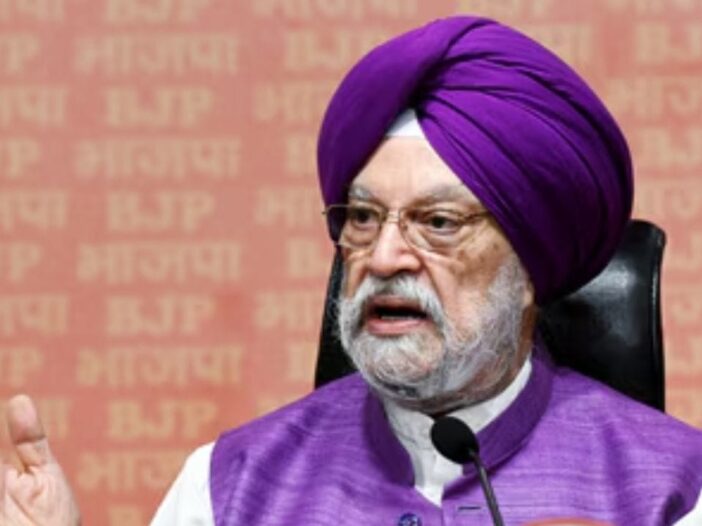
Petroleum and Natural Gas Minister Hardeep Singh Puri on Thursday said state-run oil marketing companies (OMCs) suffered ‘under-recovery’ losses of Rs 2.19 lakh crore on the sale of petrol, diesel and liquefied petroleum gas (LPG) till June 30. In fact, despite rising global energy prices, companies sold fuel to domestic customers at low rates, which led to these losses. However, in the second half of May, the government oil companies increased the prices of petrol and diesel. During that time, companies increased fuel prices by Rs 7.5. The last increase was on May 25. Since then the prices of petrol and diesel have remained high. Whereas in these 40 days there has been a decline of 28 percent in the prices of crude oil.
Huge loss to oil companies
Puri said that due to the war in West Asia, OMCs suffered a total loss of Rs 74,781 crore till June 30. In the first quarter (Q1FY27) of 2026-27, under-recovery of OMCs was Rs 19,905 crore for petrol, Rs 1.44 lakh crore for diesel and Rs 24,148 crore for LPG. He said that the under-recovery of OMCs on LPG from the previous quarters was Rs 30,720 crore. Under-recovery means the difference between the selling price and cost price of the refined product sold by the OMC.
Loss reflects overall financial performance, which includes profits and losses on all refined products. Puri said that although crude oil prices have fallen sharply to $72 per barrel from $120 per barrel in April, OMCs are still reporting under-recovery on LPG cylinder sales.
When can petrol and diesel become cheaper?
He said that if crude oil prices remain at the current level for a long time, then a decision can be taken to cut retail fuel prices. Puri said that since refiners buy crude oil at least two months in advance, the fuel currently being sold at the pumps is made from expensive crude oil. He said in a press briefing that the crude oil for the petrol and diesel that you buy today at the dispensing stations was bought two months ago. Two months ago, the price of crude oil, insurance and transportation costs were all higher. Crude oil priced at $72 (per barrel) will arrive in the country later.
Fuel prices increased in May
To compensate for the increasing losses, Indian oil retailers increased the price of petrol by Rs 7.38 per liter and diesel by Rs 7.52 per liter from May 15. This was the first increase in fuel prices in four years. Puri said that despite supply-related challenges, India efficiently faced the crisis in West Asia on the basis of its strong refining capacity. He said that the country needs to increase its storage capacity to better handle future supply disruptions.
Puri said that we have 24 refineries and 22 ports. There is stock in every refinery, cargo is moving in and out of every port and there is also floating cargo. If we add the stocks in ports, terminals, refineries and SPR (Strategic Petroleum Reserve), we have at least 76-80 days of stock. We should have more stock than this. This is a lesson.
India imports 90 percent
Heavily dependent on imports, India gets about 90 percent of its crude oil, 50 percent liquefied natural gas (LNG) and 60 percent LPG from the global market. Responding to reports of Russia importing petroleum products from India, Puri said that the purchase was not done directly through any Indian company but through traders. According to a Reuters report, Russia bought at least 60,000 tonnes of petroleum from India amid attacks on its energy infrastructure by Ukraine.

Leave a Reply