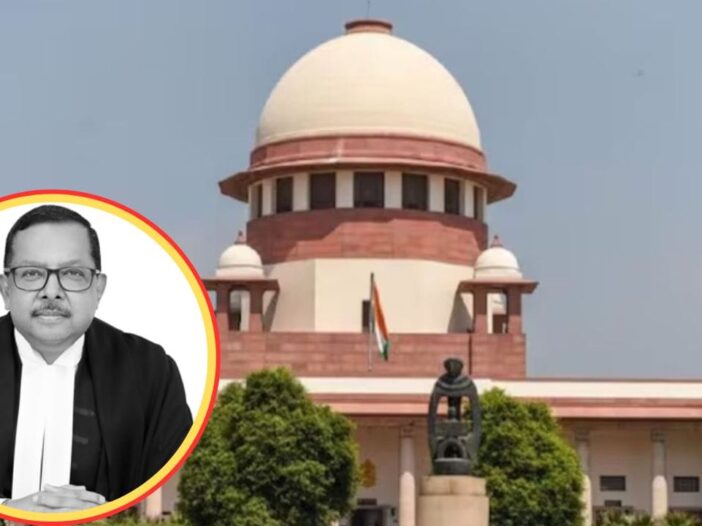
Public spaces for expressing divergent opinions are shrinking in India, and even students protesting for their rights are being arrested and denied bail. Even when they get bail, the courts impose such stringent conditions that severely curtail their freedom. Supreme Court judge Justice Ujjwal Bhuyan said these things on Saturday. Making sharp remarks, he said that the right to express one’s opinion and protest peacefully is the basic freedom of citizens. Debate and disagreement are the lifeblood of democracy, but sadly even formal activities are being criminalized.
He said that people who come to express their grief over the destruction of the environment are chased away as if they were criminals. Students protesting on campus are arrested and do not get bail for 30-40 days. They are suspended and then they have to go to court, which takes time.
Justice Bhuyan speaks on Iftar party issue in river Ganga
Referring to the denial of bail to a group of youth who had an Iftar party on a boat in the middle of the river Ganga, Justice Bhuyan asked whether bail could be denied for something that is not a crime at all. He said, ‘I am sure that eating chicken biryani is not a crime. There is no law prohibiting eating chicken on the Ganga river. He was arrested for this reason and had to stay in jail for three months. I ask myself if people can be arrested for such activity and denied bail for 3 months! Citizens are watching, people are watching.
‘Court conditions prevent us from expressing our disagreement’
He further said that courts are now imposing bail conditions that actually prevent a person from expressing his dissent. Justice Bhuiyan said, ‘For posting on Facebook commenting on the behavior of a minister who called an Indian Army officer a terrorist’s daughter, an FIR is registered and he has to get anticipatory bail. Bail is granted, but what does the court do? Asks you to surrender your passport even though there is no flight risk. Then he says not to post anything on Facebook.
Mentioned the decision of Gulfisha case
Justice Bhuyan also mentioned the decision of Gulfisha case related to Delhi riots, in which the Supreme Court had imposed strict conditions for bail. He said, ‘Look at the case of those young student activists who had to stay in jail for a long time. The court granted him bail, but also asked him not only to surrender his passport but also not to attend or address any public meeting, whether face-to-face or virtually. Imposing such restrictions severely affects their basic freedom and independence. People would be right to ask the question whether by giving such orders or imposing such conditions the court is also giving a message that one should not participate in such public activities?

Leave a Reply