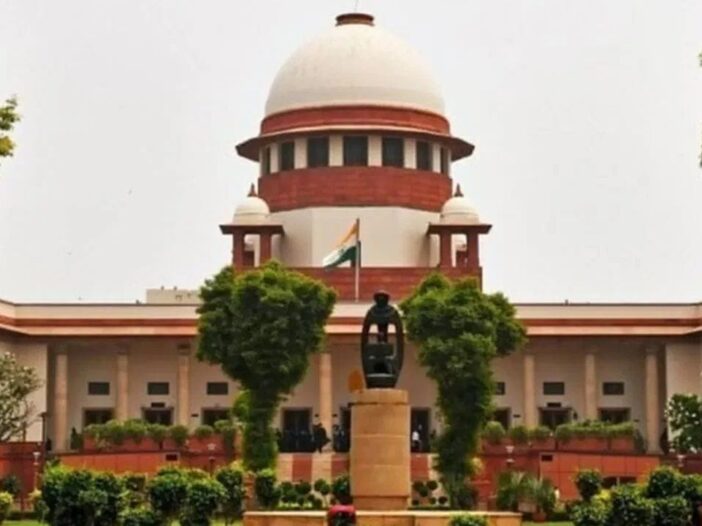
The Central Government had challenged in the Supreme Court the decision of the Gujarat High Court, in which the power of the Chairman of the National Company Law Tribunal (NCLT) to transfer cases between different benches was limited. After which the Supreme Court has issued a notice to ArcelorMittal Nippon Steel India Private Limited on Monday. Let us tell you that ArcelorMittal was earlier known as Essar Steel India Limited.
This order was passed by the bench of Chief Justice of India (CJI) Surya Kant and Justice V Mohana. This matter falls within the scope of Rule 16(D) of NCLT Rules 2016. Which gives the NCLT Chairman the right to transfer any case from one bench to another as per the circumstances. The central government argues that the Gujarat HC has wrongly placed territorial limits on the NCLT chairperson’s power to transfer cases between benches.
What is the whole matter?
The Gujarat High Court had ruled that this provision does not empower the NCLT Chairman to transfer cases outside the territorial jurisdiction assigned to a particular bench. On this basis, the High Court quashed the administrative order in which the cases related to ArcelorMittal were transferred from the NCLT Ahmedabad bench to the NCLT Mumbai bench.
What did the Center say in its petition?
Challenging this decision, the Central Government argued in the Supreme Court that the High Court had wrongly imposed a territorial limit in Rule 16(d), whereas there is no such clear restriction in this provision. According to the Centre, NCLT is a tribunal with influence throughout the country, which works under a common administrative structure. He said that the separate benches were created primarily for administrative convenience and accessibility and not to strictly fix geographical boundaries.
The government also claimed that the power of transfer under Rule 16(d) extends to inter-state transfers between NCLT benches. The petition also highlights the practical needs behind transfer orders.
stop the decision making process
The petition said that in 2024, two benches of Ahmedabad had recused themselves from hearing the cases related to Essar Steel, thereby administrative intervention was done to avoid obstruction in the judicial process. The Centre’s argument was that if the High Court’s interpretation stands, then vacancies in a particular bench may immediately stall the decision-making process.
A single bench of Justice Niral R Mehta of Gujarat High Court had already quashed the transfer orders issued by the NCLT Chairman. Subsequently, in February 2026, the Division Bench of the High Court had directed the Central Government to approach the Supreme Court.

Leave a Reply