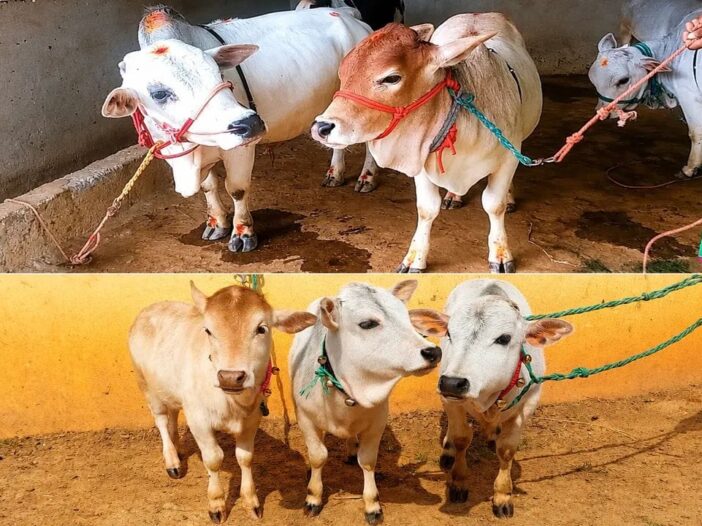
Punganur Breed Cow: Among the indigenous cows of India, Chittipotti Punganur breed of Andhra Pradesh is once again in the news due to its unique characteristics. This cow, which looks very small in size, is not known for its high quantity of milk, but for its high fat percentage, medicinal properties and low maintenance cost. This is the reason why Andhra Pradesh Government and Sri Venkateswara Veterinary University (SV Veterinary University) are running a special campaign for the conservation of this endangered breed.
Good earning from cow dung and cow urine
Punganur cow is becoming a source of additional income for farmers not only from milk but also from cow dung and cow urine. Its dung is considered very useful for organic farming. Farmers buy cow dung for about Rs 5 per kg, while the price of vermicompost prepared from it reaches Rs 150 per kg in the market. At the same time, cow urine of Punganur cow is sold for Rs 15 to 20 per liter. From the sale of these two products, cattle farmers can earn additional income of about Rs 6,000 to 7,000 every month.
Rare indigenous breed of Andhra Pradesh
The origin of the Punganur cow is the Punganur region of Chittoor district of Andhra Pradesh. In the local language it is called Chittipotti Punganur, which means ‘small cow’. It is counted among the smallest indigenous cows in the world and is considered very useful for small farmers. The ability to survive on less fodder, the ability to tolerate hot weather and the convenience of rearing in less space make it different from other breeds.
How much milk does Punganur cow give?
On an average, Punganur cow gives 2 to 5 liters of milk per day. However, the amount of milk depends on the age, health, nutrition and care of the cow. This breed is not known for high milk production, but for better quality milk. Experts say that this cow can prove to be profitable for the farmers despite its low production, because its milk has a distinct identity in the market.
6 to 8.5% fat in milk
The biggest feature of Punganur cow’s milk is its 6 to 8.5 percent fat content. Generally, the fat content of milk of foreign breeds like Jersey and Holstein Friesian (HF) is about 3.5 to 4.5 percent. Due to high fat content, milk from Punganur cow is considered more thick, tasty and aromatic. According to animal farmers, the curd made from it is very hard, tasty and durable for a long time.
Physical structure is also unique
Punganur cow is identified by its small stature. Its height is about 3.5 to 4 feet and length is about 6 feet. Its tail reaches the ground, ears are small and the front legs are slightly longer than the hind legs. Experts say that white and red colored Punganur cows are in greater demand in religious functions. Its specific physical structure gives it a distinct identity from other indigenous breeds.
The breed was once on the verge of extinction
There was a time when the number of Punganur cows started decreasing rapidly. Due to higher milk production of foreign breeds like Jersey and HF, farmers reduced the adoption of this indigenous breed, but in recent years, due to organic farming, conservation of indigenous breeds and increasing demand for high fat milk, the popularity of Punganur cow has started increasing again.
Price in lakhs, government is protecting
The price of a pure breed Punganur cow can reach Rs 5 to 6 lakh, while the price of small calves ranges between Rs 1 to 3 lakh. For the conservation of this rare breed, Andhra Pradesh Government and Sri Venkateswara Veterinary University are jointly running special programs. The university is working towards increasing the numbers of this breed through modern in vitro fertilization (IVF) technology. According to officials, at present only about 650 cows of Punganur breed are left in the state. Therefore, special efforts are being made for their conservation and promotion.
Better option for small farmers
Experts believe that due to characteristics like low fodder requirement, ability to survive easily in hot climate, high fat milk and additional income from cow dung-cow urine, Punganur cow can become a better option for small and marginal farmers. If conservation and breeding programs are successful, this rare indigenous breed will not only preserve its identity in the years to come, but can also play an important role in increasing the income of farmers and promoting organic farming.

Leave a Reply