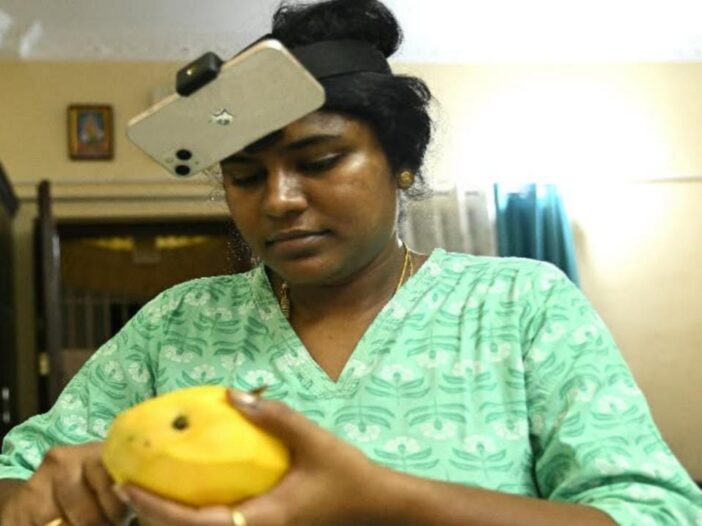
Don’t be surprised, in future you may see AI robots cutting mangoes or making tea and coffee because AI powered robots are being trained for this work. This training is being given to them by none other than Indians. In fact, by tying a camera on the head, AI robots are being taught how to work like humans. Overall, Indians are teaching their qualities to AI robots so that in the future, robots can also be seen working like ordinary humans.
This much money is being paid for 1 hour video
An Indian housewife tied a smartphone to her head and filmed herself cutting a mango, so that in the future, artificial intelligence (AI) robots can be trained to handle household chores. This woman is teaching kitchen work to an AI robot and is being paid 250 rupees (about 2.6 dollars) for one hour of video. These simple recordings are very valuable to tech companies around the world that are teaching machines how to act like humans in the real world.
Aljazeera’s report states that from her kitchen in Chennai, the capital of Tamil Nadu, this woman asked, who else will give you Rs 250 an hour to do household work? He further said, maybe in the future I myself will get a robot.
Data is sent from a specific app
This woman said, when I am not recording properly, I get an alert that hands are not detected. The recording is sent to the AI data company through a special app. This company has offices in India and America and its clients include many big multinational companies. The market for humanoid robots is growing rapidly and it is estimated that by 2050 there will be more than one billion robots in use, most of which will be used for industrial and commercial purposes.
Not one but many trainers are doing this work
55-year-old Ponni has been making flower garlands while sitting on the roadside in Bengaluru for the last decade. He has also been paid to tie a phone on his forehead. Ponni said, the next generation who may have to work like me will have to face problems.
Robots learning to imitate humans
AI chatbots and image generators process a lot of digital data, but building systems that work in real-life environments is more difficult. Developers believe that feeding egocentric data (i.e. first-person footage) into specific AI models will help robots mimic human behavior. Some AI trainers work from home, while others work in factories or specialized studios. These trainers use head-mounted cameras and motion sensors.
Read this also- Shocked by Amazon’s revelations! Data center drank 9 billion liters of water

Leave a Reply