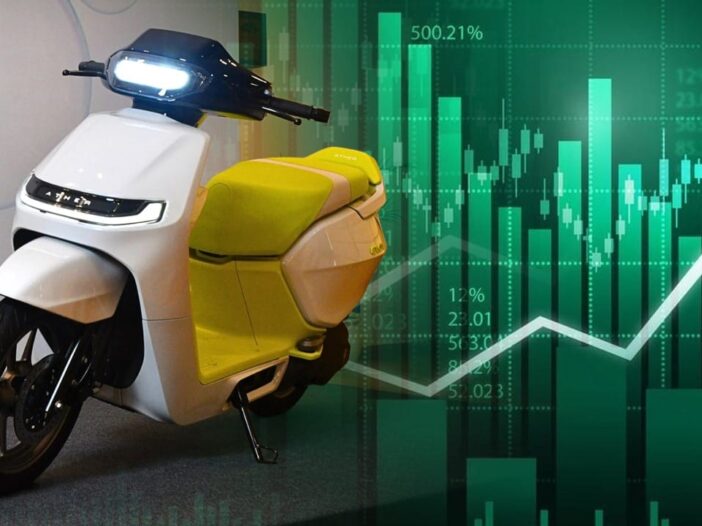
From Delhi Government New EV Policy 2026 After getting the approval, its impact was clearly visible on the auto sector shares in the stock market on Tuesday. While there was pressure on the shares of many companies related to petrol and diesel vehicles, the shares of electric vehicle manufacturing company Ather Energy created a new record.
The biggest impact was on the shares of Royal Enfield motorcycle manufacturing company Eicher Motors, which fell by about 7%. Apart from this, the shares of Bharat Forge fell by about 5%. However, later there was a significant recovery in the shares and by around 1 pm, the shares of Eicher Motors were trading down by 3.5% and the shares of Bharat Forge by about 1%. At the same time, shares of Hero MotoCorp, Sona BLW Precision Forgings and Samvardhana Motherson International also appeared under pressure.
On the other hand, shares of electric scooter maker Ather Energy rose by about 4% and the company’s shares reached a new record level of Rs 1,131 for the first time. So far in the year 2026, Ather shares have increased by about 49%. On the other hand, Ola Electric’s shares have also seen a rise of about 9.3%.
What is Delhi’s new EV policy?
Delhi government has announced that the new EV Policy 2.0 will be implemented from July 1, 2026. This policy will remain effective till 31 March 2030. Its main objective is to increase the number of electric vehicles in the capital and reduce pollution. Under the new policy, there will be new registration of only electric auto-rickshaws in Delhi from January 1, 2027. Whereas from April 1, 2028, only electric two-wheelers will be registered.
Subsidy will be available to buy EV
The government has also given many incentives to people to buy EVs. On purchasing an electric two-wheeler, you will get a subsidy of up to Rs 30,000 in the first year, Rs 20,000 in the second year and Rs 10,000 in the third year. On purchasing an electric auto, assistance up to Rs 50,000 will be given in the first year, Rs 40,000 in the second year and Rs 30,000 in the third year.
Apart from this, scrapping incentive of up to Rs 1 lakh will also be available on scrapping BS-IV and older petrol-diesel vehicles. However, there is no special incentive for hybrid vehicles in this policy. The government is preparing to spend about Rs 15,000 crore on this scheme in the next four years. In this, charging stations, EV infrastructure and other facilities will also be expanded rapidly.
Will companies making only petrol models suffer losses?
Experts believe that this policy can boost the demand for electric vehicles in India for a long time. Tata Motors, Mahindra, Ola Electric, Ather Energy and companies making electric three-wheelers can benefit from this. This policy of Delhi can also become a model for other big states in future. If other states also implement similar policies, the pace of EV adoption in India may increase further. However, it may have some negative impact on petrol bike manufacturing companies, especially Royal Enfield, Bajaj Auto and TVS Motor. But if these companies bring their electric models to the market faster, then this loss can also be compensated.

Leave a Reply