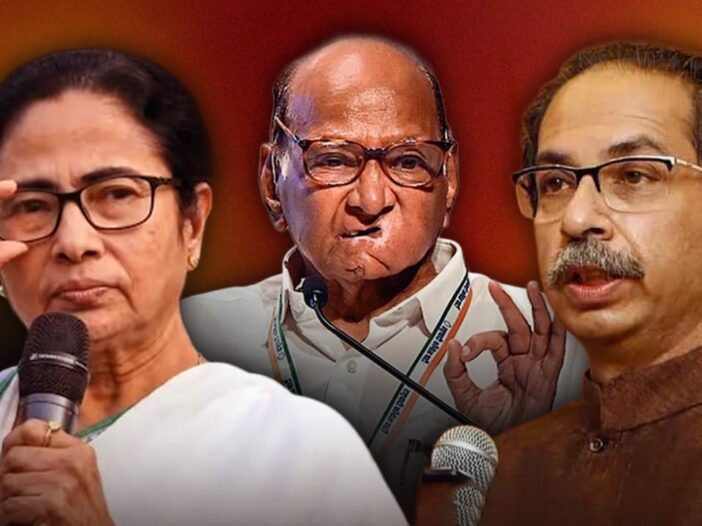
After the crushing defeat in the West Bengal Assembly elections, Mamata Banerjee’s Trinamool Congress seems to be disintegrating. First, two-thirds of its MLAs formed a separate faction and wrote to the Assembly Speaker, then two days ago, 20 TMC MPs in New Delhi wrote to the Lok Sabha Speaker demanding recognition as a separate faction.
Under this pretext, it is important to understand what are the rules for breaking up, merging and forming separate factions etc. of political parties? Come, let us understand in detail.
What does a split in a political party mean?
When leaders, MLAs or MPs of a political party separate from their original party and form a new group, it is called party breakdown in common language. Earlier there was a provision for division in the law. But now the situation has changed. Today, merely saying that a section of the party has split is not enough. In India, the rules related to defection are decided under the Tenth Schedule of the Constitution i.e. Anti-Defection Law.
What is anti-defection law?
The Anti-Defection Law was enacted in 1985. Its objective was that the elected public representatives should not change parties again and again and the democratic system should remain stable. If an MLA or MP leaves his party or votes against the instructions of the party, his membership can be lost. That means the matter does not end just by changing party. It is also important to save membership.
What was split?
Earlier when the system of split i.e. party division existed in the law. If at least one-third of the MLAs or MPs of a party seceded, it could be considered a valid division. In this situation he would have got relief from the anti-defection law. But later this arrangement was abolished. Because it was being misused.
Why is the split no longer valid?
In the year 2003, the system of split was abolished through constitutional amendment. Now membership cannot be saved merely by saying that there has been a split in the party. This means that Split does not get protection in today’s law. If a group secedes, it has to fulfill other legal conditions.
What is a merger?
Merger means joining of two political parties into one. This is also called merger. If at least two-thirds of the MLAs or MPs of a party decide to join another party, it can be considered a valid merger. In such a situation, one can get exemption from anti-defection law. This is the reason why the two-thirds number is considered very important in Indian politics.
Why is two-thirds important?
The law says that if at least two-thirds of the members of a legislative party support the merger, it can be considered valid. Suppose a party has 30 MLAs, then the support of at least 20 MLAs will be necessary. If the number is less than this, members may face disqualification.
How safe is it to have a separate party?
Forming a separate party is not considered safe in itself. Even if some MLAs or MPs separate and form a new party, questions may be raised on their membership. He may have to prove that his action is in accordance with the Constitution and anti-defection law. This is the reason that merely making a new flag and a new name does not provide legal protection.
When is it considered safe to join another party?
If an individual MLA or MP leaves the party and joins another party, his membership may be in danger. But if two-thirds of the members come together for a valid merger, the situation is different. That’s why political parties often focus on gathering numbers. The stronger the number, the stronger the legal position is considered.
Why is the role of the Speaker of the Assembly and Lok Sabha important?
The role of the Speaker of the Assembly and the Speaker of the Lok Sabha is very important in matters of defection. When a dispute arises regarding the membership of an MLA or MP, the decision usually goes to the Speaker or Speaker. They decide whether the members are guilty of defection or not. They also see whether the merger claim is valid or not. That means in many cases the final decision is in the hands of the Speaker.
What things does the Speaker consider?
The Speaker examines many facts. They see how many members are there in a particular party? How many have separated? Is the two-thirds number reached? Is the merger claim true? Have the members left the party voluntarily? Have there been activities against the party? The decision is taken on the basis of these facts.
Is the Speaker’s decision final?
Earlier it was believed that the decision of the Speaker is almost final, but now the judiciary can also review such cases. If any party feels that the decision is wrong, then he can approach the court. The Supreme Court and the High Court have intervened in many cases. Therefore, the decision of the Speaker is certainly important, but is not completely beyond judicial scrutiny.
What does the Constitution say?
The Tenth Schedule of the Constitution is the basis for matters related to defection. In this, rules for termination of membership, merger and disqualification are given. Its main objective is to maintain political stability. The law requires that the party in whose name the public elects its representative should not change the party again and again without proper procedure.
In this way, it can be said that party split in Indian politics is not only a political event but also a legal matter. Earlier split was recognised, but now this system has ended. Under current law, a merger that takes place with the support of two-thirds of the members is considered most important. Forming a separate party or joining another party is considered safe only if it is in accordance with the conditions of the Constitution and anti-defection law. For this reason the role of the Speaker of the Assembly and the Speaker of the Lok Sabha becomes very important. They decide whether the membership of an MLA or MP will continue or not. Courts can also review these decisions. Therefore, behind any political break, merger or new group, not only politics but the Constitution and law play a big role.
Breakdown of MLAs and MPs in recent years
Karnataka, 2019: The Congress and JDS government fell after the resignation and disintegration of 17 MLAs. This matter was much talked about regarding defection and the role of the speaker.
Madhya Pradesh, 2020: 22 Congress MLAs parted ways with Jyotiraditya Scindia. After this the Kamal Nath government fell and the BJP government was formed. This is counted among the biggest political breakdown cases of recent times.
Rajasthan, 2020: The rebellion of the Sachin Pilot camp came to light within the Congress. The government did not fall, but it showed that even great dissatisfaction within the party can take the form of a break.
Maharashtra, 2022: A large number of Shiv Sena MLAs parted ways with Eknath Shinde. Due to this the Uddhav Thackeray government fell. Later this matter went to the Speaker, Election Commission and Supreme Court.
Maharashtra, 2023: Many NCP MLAs separated under the leadership of Ajit Pawar. After this the politics of Maharashtra changed again. This case is also an example of how important the question of two-thirds is.
Goa: Such cases have repeatedly come to light in Goa, when MLAs from opposition parties joined the ruling party. Due to small numbers in small states, the impact of breakdown is visible very quickly.
Several examples in the North-Eastern states: Cases of defection and factionalism have been coming to light again and again in states like Manipur, Arunachal Pradesh, Meghalaya and Nagaland. Due to less numbers there, some MLAs have also been changing the calculations of the entire government.
Aam Aadmi Party: Recently, under the leadership of Raghav Chadha, two-thirds of the Rajya Sabha members announced to leave the party. There was a debate regarding the demand for his disqualification. But, nothing happened. Membership of all the members who separated from Aam Aadmi Party remains intact.

Leave a Reply