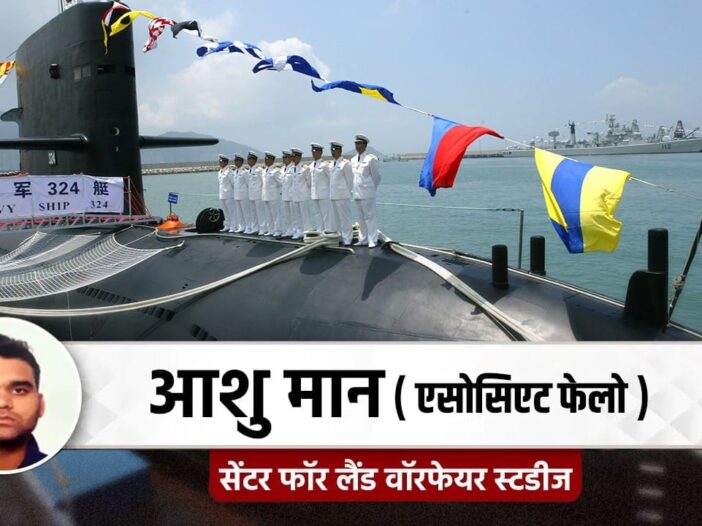
When Pakistan signed the Hangar class submarine deal with China in 2015, it was described as not just a defense deal but a major step towards increasing the country’s naval strength and achieving technological self-reliance. At that time, Pakistan had said that through this agreement it will not only get new submarines, but will also get technology from China, through which it will be able to build submarines itself in future. In the year 2020, the then Chief of Pakistan Navy, Admiral Zafar Mahmood Abbasi had said that his aim is to transform Pakistan from a submarine-running navy to a submarine-making navy. For this reason, Technology Transfer (ToT) was considered the most important part of this project.
Under the plan, four Hangor class submarines are being constructed in Pakistan’s government company Karachi Shipyard and Engineering Works (KSEW). Pakistan believes that on the basis of this experience, it will be able to develop its new submarines in future, which also includes attack submarines operating in shallow sea areas.
Big difference between technology transfer and self-reliance
However, many independent experts say that building a submarine based on a foreign design and designing it after fully understanding it are two different things. KSEW is the only institution in Pakistan that has been involved in the construction of deep sea submarines. This ability has developed over the years. In the 1990s, France provided technical assistance to Pakistan. Later China also cooperated.
Pakistan first learned the maintenance and repair work of French Daphné and Agosta submarines. After this, he gained experience in assembly, testing and sea trials of Agosta 90B submarines. Based on this experience, Pakistan started work on the Hangor project with China.
But the Hangor class submarines are much larger and more complex than the Agosta 90B. Both their weight and capacity are high. According to reports, the displacement of the Hangor class is around 2,800 tonnes, making it much more advanced than earlier submarines.
This is where the question arises whether KSEW has the capability to fully understand such a complex technology and develop it on its own in the future?
Mere assembly does not provide technology
Experts say that it is one thing to prepare a submarine as per China’s instructions, but it is another thing to understand its engineering, design and technical secrets.
If Pakistan builds submarines only by assembling parts and the real technical know-how remains with China, then it will not be able to change or upgrade these submarines as per its needs in future. That is, the real benefit of technology transfer will come only when Pakistan not only gets construction but also gets a deep understanding of design and system.
The real expense starts after purchase
The purchase price of a submarine is only a part of its lifetime cost. What follows is huge expense for decades on maintenance, spare parts, training, system upgrades and major repair operations.
The biggest challenge of the Hangar class is that almost all its important systems come from China. These include engines, electronic equipment, weapons, sensors, computer systems and spare parts.
This means that Pakistan’s submarine force will remain dependent on China’s help for a long time. If for some reason China stops the supply of technical assistance or spare parts, then the combat capability of Pakistan’s submarines may be affected.
Increasing military dependence on China
The report says that this dependence is not limited to submarines only. In the last few years, most of Pakistan’s weapons have come from China. According to the data, 81 percent of Pakistan’s total arms imports in the five years till 2024 came from China, whereas in the previous five years this figure was 74 percent.
Apart from Hangar submarines, Pakistan is already purchasing JF-17 fighter aircraft, Type 054A/P warships, missile systems and many other military equipment from China. This means that Pakistan does not have a balanced network of different countries for weapons, rather it is increasingly becoming dependent on a single country.
Most important question: Combat system
Experts believe that the most important question is regarding the combat system of the submarine. Combat systems include sensors, radar, fire control systems, weapon management systems and other electronic equipment. These systems decide how effective the submarine will be in a war situation.
China usually does not give complete information about its defense electronics to other countries. Therefore, Pakistan may be limited in replacing or upgrading these systems as per its wish. However, it is not only China that does this. America also retains technical control over modern fighter planes like the F-35. But the situation of Pakistan is different because its dependence on one country is very high.
Even Parliament does not have complete information
According to the report, till date the Parliament of Pakistan has not been publicly informed about the technology transfer terms of the Hangor Agreement. It is not clear what technology Pakistan will get, what technology it will not get, what the success criteria are and what will happen if the technology transfer is not completed.
big question of future
Pakistan Navy aims to design and develop its own indigenous submarines in the future. But for this, mere assembly experience will not be enough. This will require engineering knowledge, strong supply chains, independent design capabilities, technical research and the ability to maintain and upgrade systems without foreign help.
This is why experts are asking whether the Hangor project will make Pakistan truly self-reliant or will it prove to be a system in which Pakistan will remain dependent on China’s technology, spare parts and aid for many decades to come. This question will determine the greatest importance of this entire project and its actual success.
Also read: Bolivia has been burning for 50 days, food crisis; Why was emergency imposed?

Leave a Reply