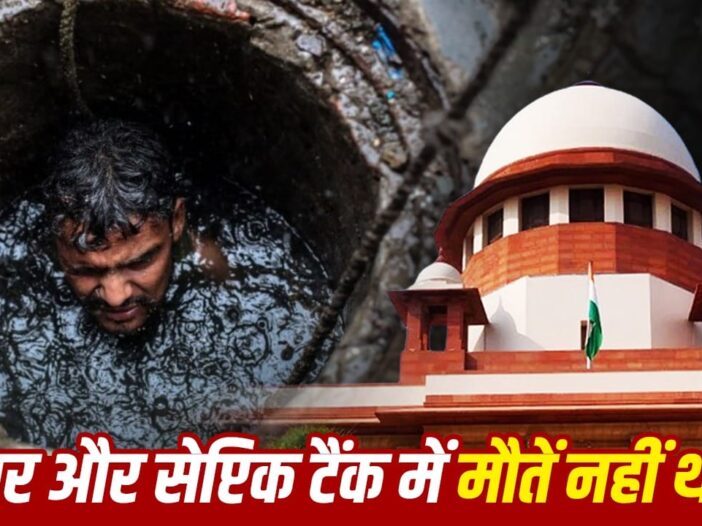
The Supreme Court has once again shown strictness on manual scavenging i.e. cleaning of sewers and septic tanks by hand in the country. The court has sent contempt notices to the Chief Secretaries of 15 states of the country including UP on this issue. The court has asked the Chief Secretary of these states why despite clear orders of the court, the deaths of people in sewers and septic tanks are not stopping. The court also said that now the time has come to fix responsibility on this issue.
On October 20, 2023, the Supreme Court had directed the Centre, all states and local bodies to completely end manual scavenging i.e. cleaning of sewers and septic tanks by hand. Such arrangements should be made that no person needs to enter the sewer or septic tank. The court had also given instructions to ensure use of machines, safety equipment, compensation and accountability in cleaning sewers and septic tanks.
How many deaths occurred in sewers and septic tanks in three years?
Figures also came before the court that during the year 2024 and 2025, about 100 people have died while entering sewers and septic tanks for cleaning. According to the data given in the Parliament by the Central Government, 165 deaths were recorded between 2023 and 2025 due to falling into septic and sewer tanks in 15 states. These include 65 deaths in 2023, 54 in 2024 and 46 in 2025.

Contempt notices were sent to the Chief Secretaries of which states?
Expressing displeasure over these deaths, the bench of Justice Arvind Kumar and Justice Vipul M. Pancholi said that the deaths are continuing despite the court order. Therefore, the Chief Secretaries of the respective states should explain why contempt action should not be initiated against them. The Supreme Court has sent notices of contempt of court to the chief secretaries of Delhi, Uttar Pradesh, Maharashtra, Rajasthan, Tamil Nadu, Punjab, Haryana, West Bengal, Telangana, Madhya Pradesh, Karnataka, Gujarat, Goa, Bihar and Jharkhand.
What is contempt?
Contempt of Court means willful violation of any court order, decision or judicial process or doing anything that hinders the administration of justice. The Supreme Court can take contempt action in such cases through Article 129 of the Indian Constitution. At the same time, the High Court has also got the same power through Article 215. The procedure for action and punishment in case of contempt is determined through the Contempt of Courts Act, 1971. Under Section 12 of the Contempt of Courts Act, 1971, if found guilty, a maximum simple imprisonment of 6 months and a fine of up to Rs 2,000 or both can be given.
How many types of contempt are there?
- Civil contempt: In such a case, if any person or government official deliberately does not follow the order, instruction or writ of the court, then it is termed as civil contempt.
- criminal contempt : When a person insults the dignity of the court, obstructs the judicial process, or tries to influence the administration of justice, it is considered criminal contempt.
When does the court issue contempt notice?
- Willful non-compliance of court order
- On non-implementation of orders by government officials
- On continuing to ignore the court’s instructions
- Obstructing the judicial process
- Conduct against the court or judges that prejudices the administration of justice
- Unnecessary delay in compliance with any decision
Why did the court send notice only to the Chief Secretaries of the states?
For non-compliance of court orders and deaths due to entry into septic tanks, a notice was sent to the Chief Secretary of the State Government because he is the highest administrative officer of the state. When the court gives orders to a state government and it is not followed, the Chief Secretary is often summoned to fix accountability. The purpose behind doing this on the part of the court is not to punish but to ensure that the government machinery and the orders of the court are followed.
These deaths are not stopping even after court order and government’s assurance.
Let us tell you that for a long time, deaths have been occurring while entering and cleaning sewers and septic tanks. Despite court orders and government assurances, there has been no reduction in such cases. The court has even said that sewers and septic tanks should be cleaned by machines and not by humans. Then figures of deaths in sewers and septic tanks are continuously emerging. The Supreme Court has already made it clear that the death of any person in a sewer or septic tank cannot be accepted. This is why the court will decide whether contempt action should be taken against the officers responsible for disobeying the orders or not.

Leave a Reply