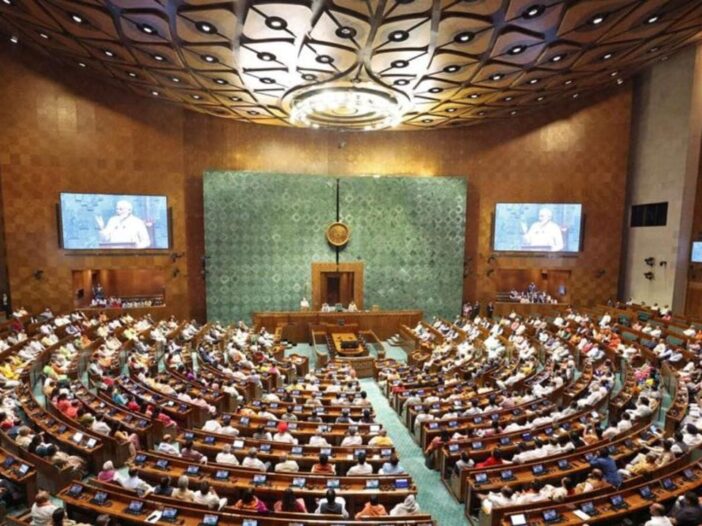
Preparations are underway to make a new law in the Parliament. The Joint Parliamentary Committee has prepared its draft report for the 130th Constitutional Amendment Bill after investigation. This bill is also being called a bill to snatch the chair of CM and Minister. According to this bill, if the Prime Minister, Chief Minister or Minister remains in jail for 30 days after being arrested in any case, then there is a provision for their automatic removal from the post. After opposition, this bill was sent to the Joint Parliamentary Committee (JPC). JPC has made 5 main recommendations in its draft report. Let us know what has been said in these recommendations.
1. When will it be mandatory for ministers to step down?
The first recommendation said that if a Union Minister, Minister of State, or Minister of Delhi/Jammu-Kashmir/Puducherry is arrested for a serious crime (which carries a punishment of 5 years or more) and remains in jail for 30 consecutive days, he will have to leave his post. On the next day of completion of 30 days in jail, i.e. by the 31st day, the Prime Minister (in the case of a Union Minister) or the Chief Minister (in the case of a State Minister) will have to advise the President or the Governor to remove this minister. If the PM and CM do not give this advice, then on the 31st day the minister will automatically be considered to have been removed from his post.
2. New provision for Prime Minister and Chief Ministers
If the Prime Minister or any Chief Minister remains in judicial custody for 30 consecutive days in a case in which there is a provision of punishment of 5 years or more, he will have to tender his resignation by the 31st day. If he does not resign, he will automatically be considered removed from his post.
3.Membership of MP and MLA will remain intact
Under this amendment, MPs or MLAs will not be disqualified. He will be removed only from the executive post (Prime Minister, Chief Minister or Minister). They will continue to be elected representatives unless disqualified under existing laws, such as the Representation of the People Act.
4. Permission for reappointment
After release from judicial custody, the person concerned can be re-appointed as Prime Minister, Chief Minister or Minister subject to the constitutional provisions and the decision of the appointing authority.
5. The committee has proposed amendments in some articles in its recommendation in which-
Article 75 (Union Council of Ministers)
Article 164 (Council of State Ministers)
Article 239AA (National Capital Territory of Delhi) is included.
Apart from this, amendments have also been recommended in the Jammu and Kashmir Reorganization Act, 2019 and the Union Territory Administration Act, 1963 (Puducherry).
The Committee has acknowledged in its recommendations that this amendment does not alter or tamper with the criminal law or the principle of presumption of innocence until proven guilty. Also, it does not affect Article 102 and Article 191 related to disqualification of MPs and MLAs. The committee is of the opinion that this law also does not affect the federal structure, because ministers can be removed from office only on the advice of the Prime Minister or Chief Minister. If such advice is not given within the stipulated time, then only the post of the concerned minister will automatically be considered terminated.
JPC will submit its final report to the Lok Sabha Speaker next week. After which, this bill can be brought in the monsoon session of Parliament.

Leave a Reply