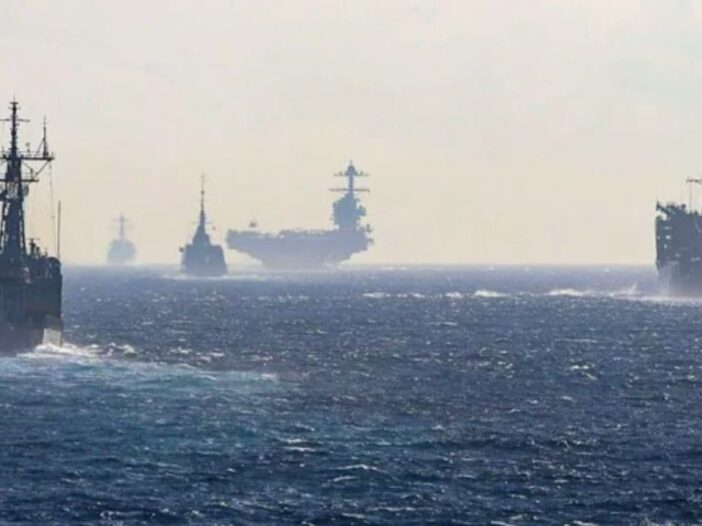
The US military claimed to have fired on another commercial ship on Friday. He said that the ship was trying to break the blockade of Iranian ports. At the same time, Iran targeted American bases around the Persian Gulf. Even after the attacks on the 13th consecutive night, there were no signs of the conflict between America and Iran slowing down. With fighting intensifying again and diplomacy uncertain, both sides have taken steps that are likely to further escalate tensions.
US embassies in the Middle East have begun warning Americans in the area that evacuation options may be limited. At the same time, Iran’s Revolutionary Guard has advised the people of neighboring countries to stay away from bases with American soldiers.
Tried to break the blockade four times
US Central Command spokesman Capt. Tim Hawkins told The Associated Press that US forces destroyed the M/T Lavin in the Gulf of Oman after it tried to breach the blockade at least four times. Hawkins insisted that the ship’s crew had been warned, but they disobeyed orders. After this the army opened fire in the engine room of the ship.
This is the second commercial ship to be idled since the military reimposed the blockade. The US Central Command said that it has also changed the route of 12 ships.
America is attacking every day
Earlier on Friday, US President Donald Trump described the talks with Iran as the most serious talks ever, while America is carrying out daily attacks. Trump told reporters, “We are fully prepared and ready to take action, but we are also talking to them.” He also said that he is in no hurry to end the war.
Iran will not bow down to bullying
Iran’s Foreign Minister Abbas Araghchi said that Iran will not bow down to America’s bullying. He mentioned ongoing talks with global powers like China and Russia, which are often at odds with the US. Also, in an interview given to the semi-official news agency Tasnim, he warned that the Islamic Republic will neither be afraid of threats nor bow to pressure.
At the center of this fight is the Strait of Hormuz, which is a vital route for energy supplies around the world. This route has been virtually closed due to Iranian attacks, causing sharp increases in fuel prices and widespread economic turmoil.
America carried out attacks in Iran and surrounding countries
In the northern Iraqi city of Irbil, where a contingent of US military advisers is stationed, security officials said on Friday that US-led forces shot down five explosive-laden drones. Repeated explosions were heard in Irbil, the capital of Iraq’s semi-autonomous Kurdish region, and plumes of black smoke were seen near its airport, which is home to a US military base. US military officials did not respond to requests for comment about the attacks.
Meanwhile, Iran’s Revolutionary Guard said it targeted a US base in Udairi, Kuwait and destroyed three sheds storing ammunition and equipment. It also claimed that it attacked a watchtower of the US Navy’s Fifth Fleet stationed in Bahrain, causing damage to it.
The US Central Command did not respond to questions regarding these claims. Bahrain and Jordan both said they intercepted airstrikes by Iran on Friday.
Attack on Revolutionary Guard naval base
According to semi-official news outlets ‘Fars’ and ‘ISNA’, the US attacked the Revolutionary Guard’s naval base in northern Iran as the US and its allies’ targets were being repeatedly attacked. There was also news of explosions on Iran’s Qeshm Island due to American bombing. The island is a base for naval assets such as drone-boats, which Iran can use to attack ships passing through the strait. In addition, explosions also occurred in Isfahan province, where a major airport and one of Iran’s nuclear sites are located.
According to reports, additional attacks were also carried out in Iran’s southwestern Khuzestan province and southern Fars province. Central Command said the new round of attacks was aimed at further reducing Iran’s ability to pose a threat to common seafarers and commercial ships transiting regional waterways as the US seeks to reopen the Strait of Hormuz, through which one-fifth of the world’s peacetime oil and gas trade passes.
Houthi attacks give Iran an edge in possible talks
According to Iran’s state news agency, a diplomatic delegation from Oman, which has been involved in mediation efforts between the US and Iran. He was in Tehran on Friday to discuss the management of shipping traffic in the Strait of Hormuz.
Iran’s ability to effectively block Hormuz and cause economic disruption far beyond the Middle East gives it a strong negotiating leverage. Its Houthi allies extended that advance when they targeted two Saudi Arabian oil tankers in the Red Sea on Thursday, increasing the risk to shipping through another vital route for Middle Eastern oil.
These attacks fulfilled the Houthis’ threat to close the Bab al-Mandeb Strait to shipping bound for Saudi Arabia. Located at the southern tip of the Arabian Peninsula, the strait connects the Red Sea to the Gulf of Aden, and about 12% of the world’s trade, including a quarter of global container traffic, passes through it.
Millions of barrels of oil had to be diverted every day
This route has become even more important for Saudi Arabia, which has had to divert millions of barrels of oil every day to avoid Hormuz. Trump has threatened to give major military punishment to the Houthis if their attacks on ships continue.
The price of Brent crude oil, the international standard, fell slightly on Friday to about US$96, but that is still much higher than before the war started, when it was trading at about US$72 a barrel. Motorists in the US saw gas prices rise, reaching an average of US$4.11 per gallon, AAA said.
No signs of diplomatic success
Apart from the economic impact, the human loss is also clearly visible. According to the report of Iran’s Health Ministry, 3,434 people have died since the start of the war. In other developments, the International Maritime Organization said at least 6,000 sailors were stranded on about 400 ships around the Strait of Hormuz. UN human rights chief Volker Turk called for immediate action to help them.
His office said sailors are stranded amid the fighting and some have been abandoned by their shipowners, leaving them to fend for themselves without food, water, fuel, medical care, electricity or means to contact their families. There have been no public signs of progress in any efforts to negotiate.
played an important role in the negotiations
Pakistan Foreign Minister Ishaq Dar, who played a key role in the previous talks, met his Iranian counterpart Araghchi on Friday. But before the meeting, Araghchi rejected any attempts at mediation, saying he did not believe there was a need for more mediators in the conflict. Instead he stressed that America should change its stance.
The US and Israel attacked Iran on February 28 and have stated different goals for the war, which include toppling Tehran’s government and ending its nuclear program. In recent days, Israel has expressed its desire to rejoin the conflict. Prime Minister Benjamin Netanyahu’s office said he will visit the US next week and meet Trump.

Leave a Reply