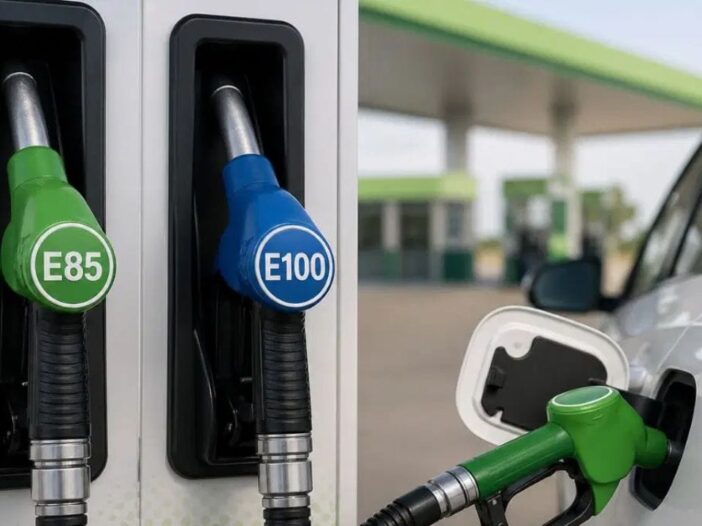
Oil companies (OMCs) are currently avoiding expanding the sales of E85 (85% ethanol and 15% petrol) fuel on a large scale. The biggest reason for this is the disappointing experience with E100 (100% ethanol) fuel. Industry officials say that the demand for fuel at about 400 Pilot E100 petrol pumps was almost negligible. In such a situation, companies want that the sales of Flex-Fuel vehicles should first increase and only then the E85 network should be expanded. The government wants to reduce dependence on crude oil imports and fossil fuels by promoting ethanol blended fuel.
A senior Indian Oil Corporation (IOC) official, who did not wish to be named, said, “We had initially made E100 available as a pilot project at about 400 pumps, but the demand for it was almost negligible. So now it has been reduced to just 5-6 outlets. The government is continuously promoting it, but we are currently monitoring the situation.”
Lack of flex-fuel vehicles becomes the biggest challenge
E100 is a fuel made entirely of ethanol, which can only be used in flex-fuel vehicles. Whereas E85 contains 85% ethanol and 15% petrol, but for this also a flex-fuel engine is necessary. Due to very less number of such vehicles in the country, the expansion of these fuels has stopped.
The industry says it will not be practical to install large numbers of E85 pumps until sales of flex-fuel vehicles reach sufficient levels.
The pace of implementing E25 may also slow down
According to the report, the government may also slow down the pace of the plan to implement E25 (25% ethanol mixed petrol). The reason for this is the concern that fuel with high ethanol content may affect the engines of existing vehicles.
According to the information, vehicles manufactured between 2012 and March 2023 were designed only for E10 (10% ethanol blend). At the same time, most vehicles manufactured before April 2025 are not completely E20 compliant.
Government’s goal is big, but the picture on the ground is different
Road Transport and Highways Minister Nitin Gadkari had last month approved the rules to legalize the use of E100. Under the plan, the target is to open about 500 flex-fuel outlets by December and about 5,000 outlets in major cities by the end of 2027. However, at present E85 is available only at about 48 petrol pumps across the country and even there the number of customers is very less.
Price also became a big reason
OMCs believe that a major reason for low demand for E85 is its price and limited savings. The price of E85 in Delhi is Rs 82.12 per liter, while petrol is being sold at Rs 102.12 per liter.
According to a study, at current prices pure ethanol (E100) is in many cases costlier than petrol by 2% to 14%. The reason for this is that the energy capacity of ethanol is less than that of petrol, hence the vehicle requires more fuel to cover the same distance. Due to this, its actual cost becomes 15% to 25% more than petrol.
According to the report, if ethanol is to be made a cheaper alternative to petrol, then its price should be between Rs 52 to Rs 63 per liter. But this price is much less than the current production cost. In such a situation, until ethanol becomes cheaper and the number of flex-fuel vehicles does not increase, it is considered difficult for oil companies to accelerate the expansion of E85 and E100.

Leave a Reply