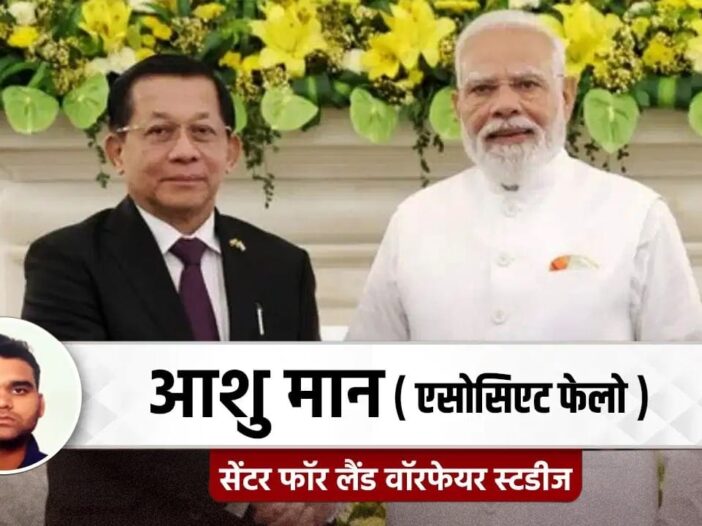
Myanmar President U Min Aung Hlaing was on a visit to India from 30 May to 3 June 2026. His first foreign visit as Myanmar’s head of state reinvigorated the relationship which had cooled down at the political level for almost six years. Beyond lip service, the visit gave New Delhi concrete opportunities on the two fronts that matter most to it. Security of its troubled eastern border and completion of the long pending connectivity corridor. Eleven agreements and understandings signed during the visit in areas such as energy, agro-processing, mining, maritime security and information sharing made this engagement more than a mere formality.
A border that India is committed to securing
India has a 1,643 km long land border with Myanmar which passes through Arunachal Pradesh, Nagaland, Manipur and Mizoram. For decades, this border remained a soft line of mutual relations and brotherhood, which was run under the ‘Free Movement Regime’ (FMR). Under this, the border communities were allowed to travel without visa up to 16 kilometers on both sides. The ethnic violence that has spread in Manipur since 2023, as well as the continuous cross-border movement of weapons, drugs and militants, have forced a major change. In February 2024, the Home Ministry took steps to end the ‘free movement regime’ and erect fencing along the entire border, as part of the government’s resolve to strengthen India’s borders.
In this background, the most important outcome of the visit from India’s perspective was President Min Aung Hlaing’s clear assurance that Myanmar’s territory would not be used for activities against India’s security. Both sides agreed to enhance cooperation on defence, security and border management and to work closely with all concerned for peace and stability on the border. The two governments also signed a Memorandum of Understanding (MoU) on maritime security and sharing of ‘white-shipping’ information. Due to this, the conversation on security went beyond the land border and reached the Bay of Bengal. An area where India is keen to monitor activities and limit strategic space for rival powers.
New Delhi’s decision here is practical because instead of creating distance, constant engagement gives India a strong position. Withdrawal will only create a void to be filled by others who have no interest in India’s concerns. For India’s border with its most security sensitive states, a cooperative government in Ne-Pee-Ta is something that India cannot afford to lose.
Important for connectivity
If one important aspect of this tour was security, the other was connectivity. Two major projects strengthen India’s land connectivity with South-East Asia and both have gained new political momentum. Kaladan Multi-Modal Transit Transport Project has made great progress. It connects Kolkata by sea to Sittwe port in Myanmar’s Rakhine state, then to Paletwa via the Kaladan River, and from there by road to Zorinpui on the Mizoram border. Sittwe Port became operational in 2023, the river terminal and dredging work has been completed, and the first section of the road from Paletwa to Kalatwa was completed in 2024.
The remaining Kalatwa-Jorinpui section is currently under construction and the target is to complete the entire corridor by 2027. Upon completion, the Kaladan Project will give India’s landlocked North-East direct access to the sea, reducing the cost and time of transport between Kolkata and Aizawl by more than half and reducing dependence on the sensitive 21 km long Siliguri corridor known as ‘Chicken’s Neck’.
The second project, the India-Myanmar-Thailand Trilateral Highway, is larger in scope. Starting from Moreh in Manipur and reaching Mae Sot in Thailand via Mandalay and Yangon, this approximately 1,360 km long highway has been built to physically connect India with the main region of ASEAN. Construction is underway on key stretches inside Myanmar, including the Kalewa-Yagi road and dozens of bridges on the Tamu-Kiyigon-Kalewa section, and both sides have agreed to accelerate the remaining work. With its future expansion to Cambodia, Laos and Vietnam, it will become the backbone of India’s ‘Act East’ ambitions.
Partnership with strategic thinking
Behind both these aspects are the ever-increasing economic relations. Trade between the two countries currently stands at approximately US$2 billion, and the Rupee-Kyat Settlement System, launched in 2024, is facilitating cross-border trade despite regional turmoil; Both sides have agreed to increase it further. The agreements reached during this visit related to energy, mining and agro-processing point towards deeper commercial integration in the future.
Looking at all these things, this visit has once again proved the importance of Myanmar at the center of India’s ‘Neighborhood First’, ‘Act East’ and ‘Ocean’ framework. For New Delhi, the point is clear: secure borders and a functional corridor to the sea are two sides of the same strategic coin, and a constructive partnership with Myanmar is the way to achieve both.
After years of limited political contact, India has used the visit to translate goodwill into concrete promises. These promises relate to security guarantees, timelines for connectivity and an economic framework that serve India’s long-term interests in a stable and interconnected eastern border region.
Also read- Monsoon stuck, how much will it affect your pocket? Prices of which things may increase?

Leave a Reply