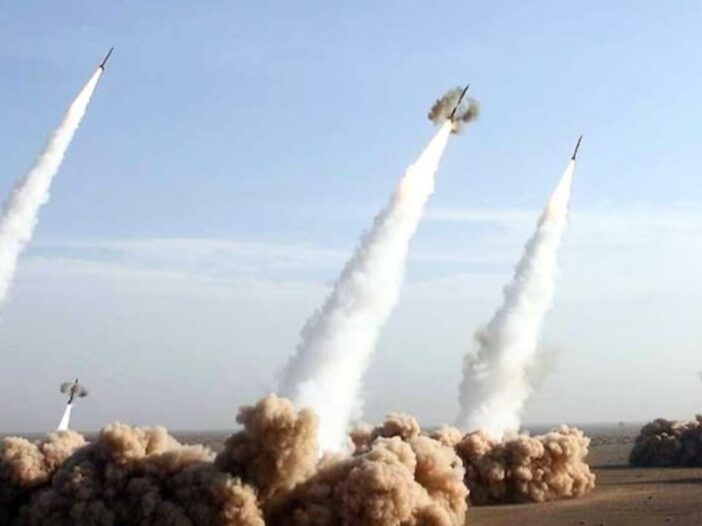
America launched attacks against Iran for the third consecutive night on Monday. Iran’s coastal surveillance systems, drone infrastructure and missile capabilities were targeted in these attacks. In a post on Twitter, US Central Command (CENTCOM) said that this latest operation was launched on the instructions of President Donald Trump. Its objective was to reduce Iran’s ability to pose a threat to civilian ships and commercial shipping in the Strait of Hormuz.
CENTCOM said, US Central Command launched strikes against Iran for the third consecutive night on the instructions of the Commander-in-Chief. These attacks will continue to inflict heavy losses on the Iranian military and reduce their ability to attack innocent civilians and commercial shipping in the Strait of Hormuz.
These latest attacks come amid rising tensions between Washington and Tehran following military clashes over the weekend. Today there was news of several explosions in the southern part of Iran. These explosions happened when the US Central Command (CENTCOM) had announced a new round of attacks on the country.
Initial reports said there were explosions in the port city of Bandar Abbas and on the island of Kish. Later, Iran’s Fars news agency reported that several explosions were also heard in the city of Jam and Qeshm Island in Bushehr province.
Threat to target Pickaxe Mountain
Earlier, Trump had indicated that more military action could be taken. In an interview, the US President warned that Iran would be attacked strongly. This indicates that Washington wants to maintain pressure on Tehran in the coming days. The US President said that military operations against Iran could continue for two to three weeks, indicating a longer campaign against Tehran.
Speaking to conservative radio host Hugh Hewitt, Trump also threatened to attack Iran’s ‘Kuh-e-Kolang Ghaz La’ (commonly known as ‘Pickaxe Mountain’). He described it as a potential target for a good, big, and forceful attack on the front door.
Pickaxe Mountain is a fortified nuclear facility built deep within the Zagros mountain range in central Iran. Trump said during the interview, we are going to destroy Pickaxe Mountain. Tell the Iranians to be prepared. They can’t do anything about it.
Blockade on Iran in Hormuz reimposed
On Monday, both America and Iran asserted their rights over the Strait of Hormuz. This increased tensions in the Middle East after the weekend attacks and raised new doubts about the prospects of diplomacy. The new tensions escalated when Iran attacked a container ship in Hormuz off the coast of Oman on Sunday, bringing the strategically important waterway back into conflict. After this incident, America launched new attacks on Iranian targets.
Trump said that America will act as the guardian of the Strait of Hormuz. He announced the reimposition of the blockade on Iran and the imposition of a 20% duty on eligible cargo passing through this strategic waterway. He said Iranian ships would no longer be allowed to pass through Hormuz, while other ships would be charged a fee for safe passage.
Trump wrote on social media, we are reimposing the ‘Iranian blockade’. It has this name because it only prevents ships or customers from Iran from coming and going. He said all other countries will continue to have unhindered access to Hormuz and this fee will help cover the cost of maintaining security in the area.
The Strait of Hormuz, located at the entrance to the Persian Gulf, is one of the world’s most important energy chokepoints. Historically, about one-fifth of the crude oil and natural gas traded worldwide passes through this route.
America and Iran’s claims regarding waterway
This latest confrontation has taken place at a time when an interim arrangement of 60 days was made with the aim of paving the way for talks to end the tension permanently. Instead, the agreement has been marred by a series of military conflicts over the future of the Strait of Hormuz.
On Monday, US Central Command (CENTCOM) said US forces struck dozens of targets inside Iran, including air defense systems, radar installations, missile and drone capabilities and small naval boats. The Strait of Hormuz is an important maritime corridor for global trade, CENTCOM said in a statement. Iran has no control over this.
Iran immediately rejected this claim. The Islamic Revolutionary Guard Corps (IRGC) said the waterway falls within Iranian territory and accused Washington of illegal interference. The IRGC said, the Strait of Hormuz is our territory, and we will not allow an arbitrary and child-killing army from the other side of the world to continue its illegal interference.
These conflicting claims have raised concerns about maritime security and global energy supplies, while international efforts to prevent a major conflict appear to be becoming more difficult. Warning of the risks associated with a further worsening of the situation, UN Secretary-General Antonio Guterres said a resumption of large-scale fighting would have dire consequences.

Leave a Reply