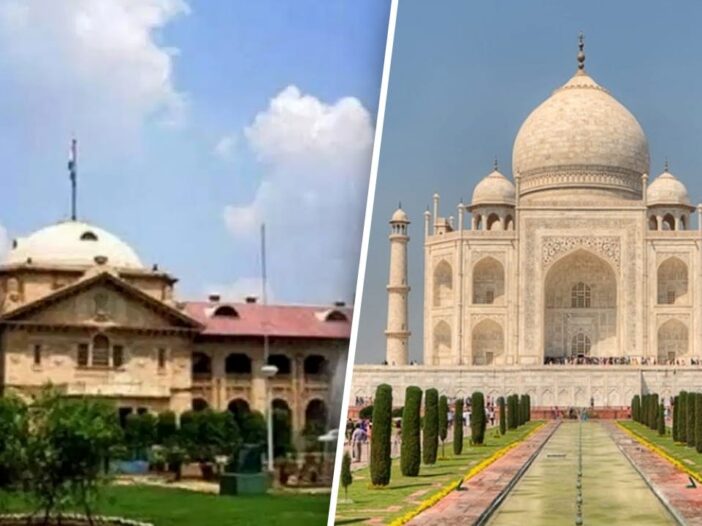
The Allahabad High Court on Monday issued a notice to the Center and the Archaeological Survey of India (ASI) seeking their response on a petition challenging the Agra Court’s order refusing to survey the Taj Mahal. The bench of Justice Rohit Ranjan Aggarwal gave this order after listening to advocate Hari Shankar Jain appearing on behalf of the petitioner. The petitioner claims that this world-famous monument is actually an old Hindu temple named “Tejo Mahalaya” dedicated to Lord Shiva.
Let us tell you, Agra Court Taj Mahal Had refused to appoint Advocate-Commissioner for inspection, photography and videography. The petition has been filed on behalf of the deity “Lord Shri Agreshwar Mahadev Nagnatheshwar Virajman”, through his next friend, Advocate Hari Shankar Jain and several other devotees.
Tammahal is a Hindu temple… petitioner’s claim
According to PTI News, the petitioner sought a declaration and stay that the monument is a Hindu temple and, therefore, the petitioners and members of the Hindu community should be allowed to worship inside the Taj Mahal.
He had specifically said that Hindus have the fundamental right to ‘darshan’ and ‘worship’ inside the monument under Article 25 of the Constitution of India. In 2019, an application was made to appoint an Advocate Commissioner to survey the Taj Mahal. However, the Additional Civil Judge (Senior Division), Agra, rejected the application on the grounds that the plaintiffs had failed to file revenue documents (such as Khasra or Khatauni) to ascertain the correct Gata number, and because the stated boundaries and area of the property (77 bighas) did not match with the defendants’ documents.
In April this year, the Additional District Judge of Agra had considered a revision petition against this order as non-maintainable. Challenging both these orders, the plaintiffs moved the High Court citing the following specific historical and architectural claims made in the original case: The old temple of Tejo Mahalaya, which houses the deity Agreshwar Mahadev Naganatheshwar Virajman, was built by Raja Paramardi Dev in 1155-56 AD.
Shahjahan had snatched ‘Tejo Mahalaya’ palace from Raja Jai Singh.
With time, this monument came under the control and ownership of Raja Man Singh and later in the 17th century, Raja Jai Singh of Jaipur kept it under his control. Mughal ruler Shahjahan snatched the ‘Tejo Mahalaya’ palace from Raja Jai Singh and converted it into a memorial in the memory of his dead queen. For this conversion, some parts of the monument were modified to incorporate some Islamic features.
There are at least 109 archaeological features and historical evidence which prove beyond any doubt that the property in question is a Hindu temple. The marble dome is topped by a ‘Kalash’ and is “decorated with lotus petals”, suggesting a Hindu place of worship.
A structure on the south-east corner of the property in question is recorded in Archaeological Survey of India records as a “cow shed”, an essential part of every Hindu temple complex, but not of a Muslim mausoleum.
Permission to offer Namaz is illegal
The lawsuit also claims that the Archaeological Survey of India (ASI) had ‘unlawfully’ allowed Muslims to offer ‘Namaz’ on Friday, while restricting movement and closing several floors of the building complex. Those filing the case claim that using the property for purposes other than Hindu ‘puja’ and worship of God is illegal.
Regarding this order, the petitioner says that the court’s reasoning is “patent”. He says that the application was rejected on such grounds which are completely irrelevant for the purpose of appointment of the commissioner. The petition emphasizes that there is no dispute regarding the identity of the suit property as it is a well-known old monument. Furthermore, the petitioners argue that the physical characteristics, structural features and closed areas of the monument cannot be effectively proved by oral evidence alone.
They say that they do not have unrestricted access to the monument which is under the control of ASI, which makes a court-appointed photographer and videographer necessary for an effective decision. In this background, the petitioner has prayed that the High Court should set aside the orders of the Agra Court and direct the trial court to decide the application for Advocate-Commissioner on its merits. Further, an interim stay application has been sought that the High Court direct the Director of ASI to take photographs from inside and outside the building in the presence of the petitioners and file them in the present proceedings.
Read this also- So Shahjahan got the idea of building Taj Mahal from here, know where the symbol of love was built before Agra

Leave a Reply