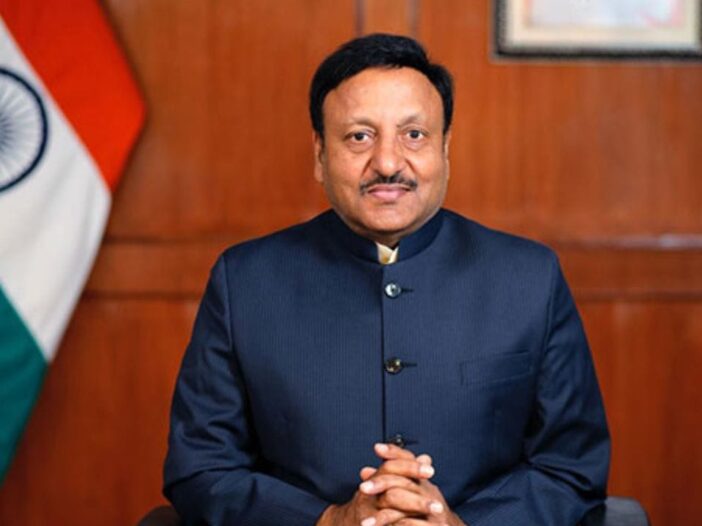
The Board of Directors of HDFC Bank has played a big masterstroke regarding the appointment of Chairman. The board of the bank has announced the appointment of former Chief Chulave Commissioner Rajeev Kumar as the new chairman. Now the approval of RBI is awaited. HDFC Bank said in a regulatory filing that the Board of Directors has approved the appointment of Rajeev Kumar as an independent director of the bank for four years. This appointment will be effective from June 30, 2026. The bank said that his appointment is dependent on getting the approval of the Reserve Bank of India. After getting approval from the central bank, Kumar will be appointed part-time chairman of the bank for three years. This appointment will come into effect from the date of approval by RBI. Kumar later became the 25th Chief Election Commissioner of India.
Who will Rajeev Kumar replace?
Former Chief Election Commissioner Rajiv Kumar will replace Atanu Chakraborty, who abruptly resigned in March citing ethical concerns. The bank has said that Rajiv Kumar took over as Secretary of the Department of Financial Services (2017-2020) at a time when public sector banks were facing many challenges. These included issues like large amount of unidentified non-performing assets (NPAs), lack of capital, misuse of equity and debt. It said that through sound policy and its implementation, Kumar worked to clean up and strengthen the bank’s books.
He mandated clear identification and provisioning of NPAs and fixed the liability of borrowers under the Insolvency and Bankruptcy Code (IBC). Kumar, 66, a former 1984 batch IAS officer and former Finance Secretary of India (February 2020), has also been appointed Additional Director (Independent) of the bank for four years, with effect from June 30, 2026, the bank said in an exchange filing.
MD’s tenure is also about to end
Meanwhile, the current tenure of Shashidhar Jagadishan as Managing Director (MD) and CEO of HDFC Bank is going to end on October 26, 2026. He assumed this role from October 27, 2020. His current three-year tenure (from October 27, 2023 to October 26, 2026) was approved by the RBI in 2023. It is expected that the board will recommend Jagadishan for a third term as MD and CEO after getting the approval of RBI. The reappointment process, which was stalled due to external legal review, can now proceed as law firms have submitted reports giving a clean chit to the bank.
Strong policy and expert in implementing it
Kumar also served as Chairman of the Public Enterprises Selection Board (PESB) for some time. He took charge as Secretary of the Department of Financial Services (DFS) from 2017 to 2020, when public sector banks were facing many challenges. These included large amounts of hidden non-performing assets (NPAs), lack of capital, obstacles in giving new loans, and misuse of equity and debt to take new loans (such as gold plating and diverting funds), etc. The sector was also facing governance challenges like large consortiums, NBFCs struggling to meet the micro-credit shortfall after demonetisation, and Ponzi schemes defrauding people.
Within two weeks of joining DFS, the accounts of about 3.38 lakh shell companies (fake companies) were frozen. After this, Ponzi schemes were banned by passing the ‘Banning of Unregulated Deposit Schemes Act, 2019’. Through strong policy and implementation, he worked to repair the balance sheets of public sector banks. For this, he mandated clean identification and provisioning of NPAs, and fixed the accountability of borrowers under the ‘Insolvency and Bankruptcy Code’.
He headed many important institutions shaping the country’s financial structure, including the Central Board of the Reserve Bank, Financial Stability and Development Council, Financial Sector Regulatory Appointments Search Committee, Secretary of Cabinet’s Appointments Committee, Public Enterprises Selection Board, Banks Board Bureau and the boards of SBI and NABARD. He was also a part of the Expert Committee on Economic Capital Framework of the Central Bank and the Committee on Restructuring of NITI Aayog.
Initiative to make banking sector clean
Kumar took several steps to clean up the banking sector — such as taking strict action against illegal financial activities, strengthening regulatory oversight over co-operative banks and fixing accountability in cases of large defaults. Providing passport information was made mandatory for loans of Rs 50 crore and above, so that big borrowers could not flee the country before any action was taken.
Measures like fraud checks, special monitoring of loans above Rs 250 crore and IT-based risk scoring based on more than 34 factors replaced the ‘soft signals’ and lax controls that were often involved in the loan granting process by large groups (consortiums) of up to 25 banks. The relationship between creditor and debtor was completely redefined, giving a clear message that loans should be given wisely and debtors must repay them.
An important part of this transformation was the recapitalization of public sector banks (PSBs), in which more than Rs 3 lakh crore was infused, which helped in restoring their solvency (financial strength) and lending capacity. Along with this, a big process of consolidation of banks was also started, under which 12 strong banks were created by merging 27 public sector banks. Regional Rural Banks (RRBs) were also transformed into a more efficient structure of ‘one state – one RRB’. He led the process of merging these PSBs.

Leave a Reply