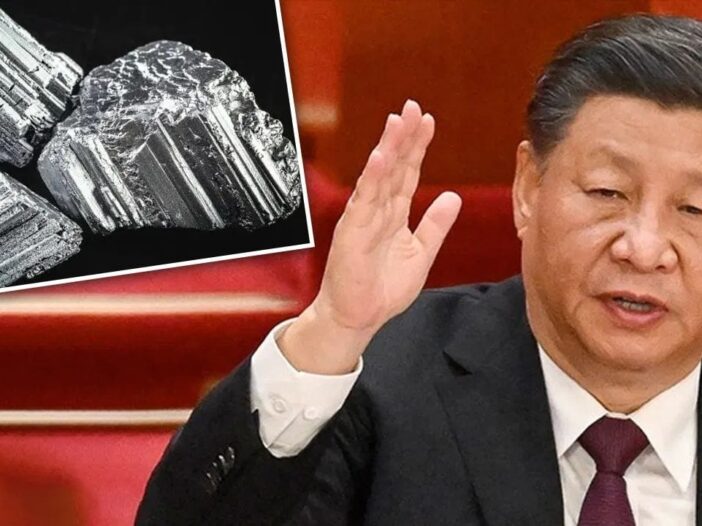
A huge crisis is looming over the global tech, automobile and defense sectors. According to the International Energy Agency (IEA)’s ‘Global Critical Minerals Outlook 2026’ report, if China fully implements the restrictions imposed on the export of rare earth elements, then industrial production worth $6.5 trillion (about $6.5 trillion) every year in the whole world outside China could be stalled or affected. This restriction is based on China’s monopoly in the global supply chain and the ongoing geopolitical conflict with the US. It is the result of (geopolitical) tension. Let us try to understand it in detail…
What are ‘Rare Earth’ minerals and why is there a stir?
Rare Earths are a group of 17 such minerals, which are required in very small quantities in modern technology, but without them it is impossible to make high-tech products. Sensitive things like smartphones, electric vehicles (EVs), wind turbines, fighter planes and satellites are completely dependent on them. The biggest concern for global industries is that even though these minerals constitute a very small part of the total cost of a product (e.g. less than 1 percent of the total value of an electric car), stopping their supply can shut down an entire manufacturing plant worth billions.
Excessive centralization of supply chain
According to Bloomberg report, IEA Executive Director Fatih Birol has warned that a huge economic value of the world depends on a few selected and very limited critical minerals. The problem is that their supply chain is highly concentrated, due to which it becomes extremely sensitive and weak. In October last year, China had tightened the licensing rules by expanding the scope of export restrictions. Although the full implementation of these stringent rules has been postponed to November 2026, this sword continues to hang over the head of the global market.
IEA’s ’emergency plan’ to deal with the crisis
To overcome this global weakness, the IEA has advised the countries of the world to create a multilateral stockpiling.
11 High-Risk Minerals: The IEA has identified 11 most risky minerals for which emergency backup is necessary.
How much will it cost: To build this stockpile, approximately 9.2 billion dollars ($9.2 billion) will have to be purchased initially, and its annual maintenance cost will be around 900 million dollars ($900 million).
Like economic insurance: According to the report, although this expenditure may seem huge, it is like a very modest ‘mineral security premium’ or economic insurance in the face of a potential loss of $6.5 trillion.
Is China’s influence decreasing?
Countries of the world are now taking active steps to reduce their dependence on China. Government financial investment for critical minerals projects has quadrupled to 65 billion doners between 2023 and 2025.
|
Area/Country |
2023 stake in |
2025 stake in |
2035 Estimate of |
|
China (refining market share) |
90% more than |
85% |
70% may fall to |
|
America and Malaysia |
Less |
increasing investment |
Major stake in rare earth refining |
There is some diversification in the case of rare earths, but in the case of other energy minerals like nickel (where Indonesia is on top) and refining of other metals, global monopoly has deepened. America and European countries will see the maximum impact (almost half) of this ban. Experts believe that even though western countries are claiming to be self-reliant, it may take many years for the world to completely get out of this ‘chokehold’ control of China.

Leave a Reply