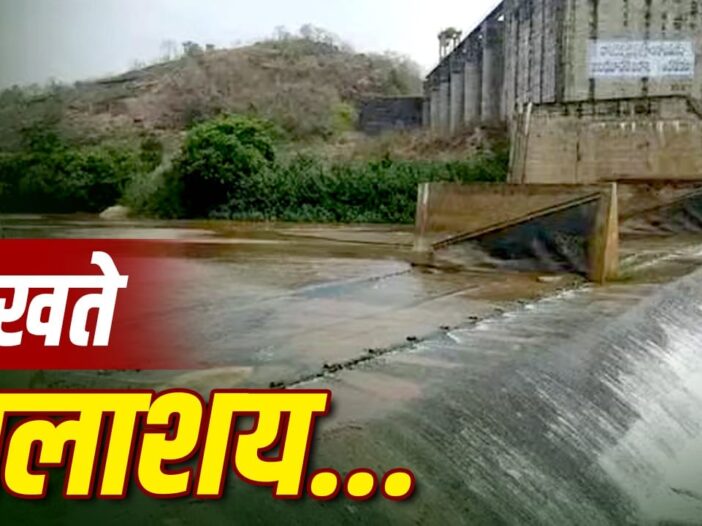
Many parts of the country have received good rainfall in the last 10 to 15 days. There are flood like situations in many areas of Gujarat, Kashmir and Assam. Rivers are in spate in states like Bihar. But despite good rains, the condition of many reservoirs in the country is a matter of concern. According to the latest bulletin of the Central Water Commission (CWC), water storage in 166 major reservoirs of India is still less than normal. This situation is when half of the monsoon has passed in the country.
According to the data presented by the Central Water Commission (CWC) till July 23, there is 70.432 billion cubic meters (BCM) of water in 166 major reservoirs of the country. This is only 38.37 percent of their total live storage capacity. This is approximately 36 percent less than last year. But this level is still close to the average, but such a huge decline in water storage in the reservoirs in a year is definitely a matter of concern.
Where is the least water in the reservoirs?
Water in 47 major reservoirs of South India is only 30.26% of their capacity. This is much lower than both last year and normal levels. Especially the water storage left in many reservoirs of Telangana, Karnataka, Tamil Nadu and Kerala can create a very serious situation. About 57% less water than normal has been recorded in the reservoirs of Telangana.
The condition of the reservoirs of North India and Central India is also not very good. Also the water level in the reservoirs is lower than normal. Reservoirs in North India are filled only up to 35.58% capacity. At the same time, there is only 39.11% water in the reservoirs of Central India. However, Eastern India and Western India have benefited from the rains in the last 2-3 weeks. Water storage in reservoirs in Assam, Meghalaya, Odisha, Maharashtra, Gujarat, Goa is more than normal. But despite this, its level is not equal to last year.

Jalasay
What is the status of reservoirs at the state level?
- Water in Telangana reservoirs is 57% less than normal. This is one of the most affected states.
- The water level in Karnataka’s reservoirs this year is about 40% less than last year. According to the state government, only 40% water is left in the reservoirs here.
- There is less water than normal in Kerala reservoirs. Here too there is 40 percent less water compared to last year. Big reservoirs like Periyar are also affected.
- On an average, about 41% of the total capacity of water is available in the reservoirs of Tamil Nadu.
- Even in the reservoirs of Madhya Pradesh, 39-40 percent water is left.
- In the beginning of July, 43 to 45 percent water was available in the reservoirs of Uttar Pradesh.
How many reservoirs are on the verge of drying up?
In the report of the Central Water Commission (CWC), water in 54 out of 166 reservoirs is 80% or less of the normal level. Out of these, 22 reservoirs have half or less of the normal water left. These include important reservoirs like Srisailam, Nagarjuna Sagar, Tungabhadra, Krishnaraja Sagar, Periyar, Tawa, Vaigai, Aliyar and Singur.
Why the reduction in water storage in reservoirs?
- Now the question arising is that if there has been rain in recent times, then why is the water storage in the reservoirs not increasing. The biggest reason behind this is the uneven distribution of monsoon. There was about 40% rainfall deficiency across the country in the month of June.
- During the monsoon, the country received almost normal rainfall between July 16 and 22, but the total rainfall from June 1 to July 25 was still 15% less. This clearly means that the deficiency of early monsoon has still not been compensated.
- Due to excessive rainfall in a short period of time, water is not being stored properly in the reservoirs. In fact, when there is excessive and heavy rain, the water often flows out rapidly instead of accumulating in the reservoirs. Due to this the dams do not get the required amount of water.
- Lack of water in reservoirs causes problems ranging from hydropower production, industry to irrigation. In such a situation, as soon as water is available in the reservoirs, it is used for these purposes. This also affects the water storage capacity of reservoirs.
If this situation continues then there could be a big water crisis
If there is no rain in the coming days and there is shortage of water in the reservoirs, then its first impact will be visible on Kharif farming. The productivity of crops may be affected. Apart from this, there may be increased pressure on drinking water supply in cities and water availability for industries. Apart from this, hydropower production may also be affected. This may result in reduction in power generation capacity. As a result, we may have to face a huge power crisis. At the same time, water crisis is looming in this situation.

Leave a Reply