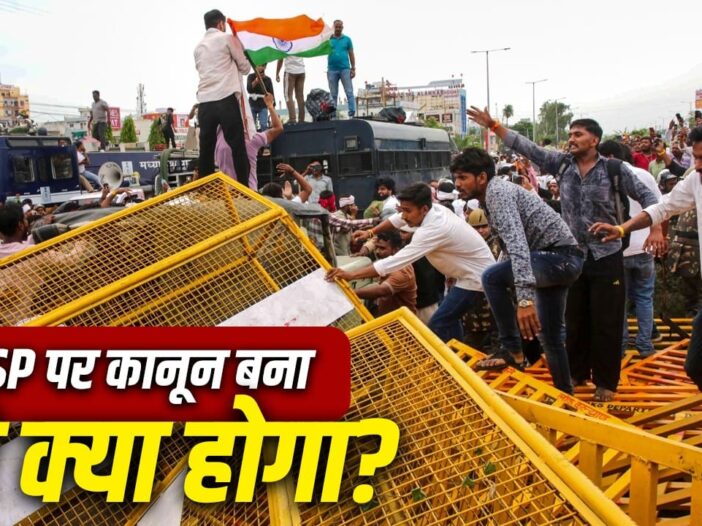
There is a long and complex debate going on between farmers and the government regarding the demand to make Minimum Support Price (MSP) a legal right. Recently, the Supreme Court has issued a notice to the Central Government on a petition challenging the structure of MSP. On the other hand, on July 22, 2026, NCP (Sharadchandra Pawar) chief Sharad Pawar has written a letter to Prime Minister Narendra Modi raising the demand for deepening agricultural crisis in Maharashtra and legal guarantee of MSP.
Here, National Farmers Organization leader Paramjit Singh says that in the Chandigarh meeting, the government had talked about giving legal guarantee of MSP on the production of pulses, oilseeds as well as coarse grains, but it has not been implemented yet. Actually, in February 2024, a round of meetings were going on in Chandigarh between the Central Government and farmer organizations regarding MSP. After all, why is the government hesitating to legalize MSP? Let us understand this entire issue from the perspective of technical, economic and ground reality…

Why is the government holding back from giving legal guarantees?
There are three main concerns of the government behind this.
- Fear of inflation: Due to legal obligation on MSP, the prices of food items in the market may increase rapidly.
- Dissatisfaction of traders: Due to strict laws, traders can stay away from the market.
- Lack of system: The government does not have the infrastructure to purchase all 23 crops.
The production of oilseeds in India is 39 million tonnes, which is only 40% of our requirement. To fulfill the remaining shortage, edible oil worth Rs 1.76 lakh crore is imported from abroad. At the same time, the production of pulses is 26 million tonnes, which is only 50% of the requirement. Despite this, legal guarantees have not been implemented on them.
Battle of the Formulas: C2 vs A2+FL
The real controversy over MSP is on how the cost of the crop should be determined.
- A2+FL (existing system): This includes the farmer’s cash expenses (seeds, fertilizers, labour, irrigation) and the estimated value of the family’s labour.
- C2+50% (Swaminathan Commission recommendation): This is a comprehensive formula. In this, along with A2+FL, the estimated rent of the farmer’s own land and interest on agricultural equipment (capital) are also added, and then 50% profit is given on it.
What do the statistics say?
According to CACP (Commission for Agricultural Costs and Prices) data, C2 cost is 35-45% higher than A2+FL. In recent years, while the C2 cost for paddy was Rs 4,000 to 7,000 per quintal, under A2+FL it was only Rs 2,800 to 5,000. According to the Agricultural Census of 2021, 86% of the farmers in the country are small and marginal, who have 1 to 2 hectares of land. The current A2+FL formula structurally underestimates their profits.
Burden of ₹12 lakh crore on economy and budget
Critics argue that the legal guarantee of MSP will be a burden on the treasury. According to a 2022 study by ICRIER and government estimates, if all 23 crops are compulsorily purchased on the C2+50% formula, Rs 8 to 12 lakh crore will be spent annually. For comparison, the country’s current food subsidy bill in the Union Budget for 2024-25 is around Rs 2 lakh crore. Apart from this, there is a separate expense for the huge infrastructure that will be required for storage and transportation of the crop across the country.
Market imbalance and environmental threat
With legal guarantee, farmers will insist on growing only MSP crops (wheat-paddy). According to the estimates of the Ministry of Agriculture (MoA&FW), 28.2 billion cubic meters of groundwater is being extracted every year for paddy cultivation in Punjab alone. The CACP has consistently warned in its annual reports from 2020 to 2025 that imposing a fixed legal formula would upset the market demand-supply and environmental balance.
Strictness of World Trade Organization (WTO)
India’s MSP procurement comes under the WTO’s amber box, which prohibits giving subsidy of more than 10% of the total agricultural production value. India is currently protecting itself by using the ‘Bali Peace Clause’ of 2013. If legal guarantees are implemented on all 23 crops, this limit will be breached and India will have to face international trade disputes.
Who benefits from MSP?
MSP benefits are highly unequal. According to NITI Aayog (2021), barely 6% of the farmers in Bihar, West Bengal and Jharkhand are able to sell their produce at MSP. In UP and Odisha this figure is less than 10%. 80-85% of the national procurement is limited to wheat and paddy from only 2-3 states (Punjab, Haryana etc.).
Sharad Pawar’s letter and ground reality
In a letter written to PM Modi on July 22, 2026, Sharad Pawar said that a farmer is committing suicide every 3 hours in Maharashtra. There have been 2,700 deaths in Vidarbha and Marathwada in the last one year. Only 5-12% of Maharashtra’s soybean, cotton, pulses and paddy is purchased at government rates, due to which farmers have to sell their crops in the market at 15-25% lower prices. Apart from this, Pawar has demanded an end to the delay in PM Fasal Bima Yojana (PMFBY), problem of fake seeds/fertilizers, reducing GST on agricultural equipment, audit of corruption in irrigation projects (Jal Jeevan Mission) and changes in NDRF rules. According to NCRB, more than 10,000 farmers are committing suicide every year in the country.
What is the government’s answer on MSP?
On July 28, 2026, five main questions were asked to the government in the Lok Sabha regarding the legal guarantee of MSP. It was asked whether the farmers are demanding a law on MSP, whether the government is going to take any decision on this or not, whether the legal guarantee of MSP will increase the income of farmers and reduce the exploitation of middlemen. It was also asked that if farmers are in crisis due to increasing cost of farming and decreasing income, then how will the government provide a permanent solution to it.
Minister of State for Agriculture and Farmers Welfare, Ram Nath Thakur, instead of answering these questions separately, answered them together. The government said that it decides the MSP of 22 crops based on the recommendations of CACP (Commission for Agricultural Costs and Prices) and as promised in the budget of 2018-19, efforts are being made to give farmers a price of at least one and a half times the cost of production. The government did not give any direct decision on the legal guarantee of MSP. Instead, schemes like PM-Asha, Price Differential Payment, PM-Kisan and crop insurance were described as steps taken to help the farmers. According to the government, there has been a significant increase in purchases at MSP and direct payments to farmers from 2014 to June 2026. A huge MSP payment of Rs 27.80 lakh crore has been made to the farmers.

What is the way forward?
Agriculture is a state subject under the 7th Schedule (List II) of the Constitution. Therefore, it will not be easy to implement the same MSP law in the entire country. The needs of farmers and farming conditions are different in different states. For example, wheat is cultivated more in Punjab, whereas crops like sugarcane, cotton and soybean are important in Maharashtra.
In such a situation, one option could be ‘price deficiency payment’. In this, instead of purchasing every crop, the government can directly give the difference between the MSP and the market price to the farmer in his account. The Bhavantar Payment Scheme implemented in Madhya Pradesh during 2017-19 was based on a similar system.
In this way, the huge burden of procurement, storage and transportation on the government can be reduced and the challenge of WTO rules can also be reduced. However, just making MSP law will not be enough. To provide real benefits to the farmers, facilities like procurement centres, warehouses and cold storage will have to be expanded in states like Bihar, Maharashtra and Uttar Pradesh, so that MSP is not limited to just papers but reaches the farmers.
Also read: 13 accused-360 witnesses and 422 documents… NEET paper leak-2026 paper leak cases

Leave a Reply