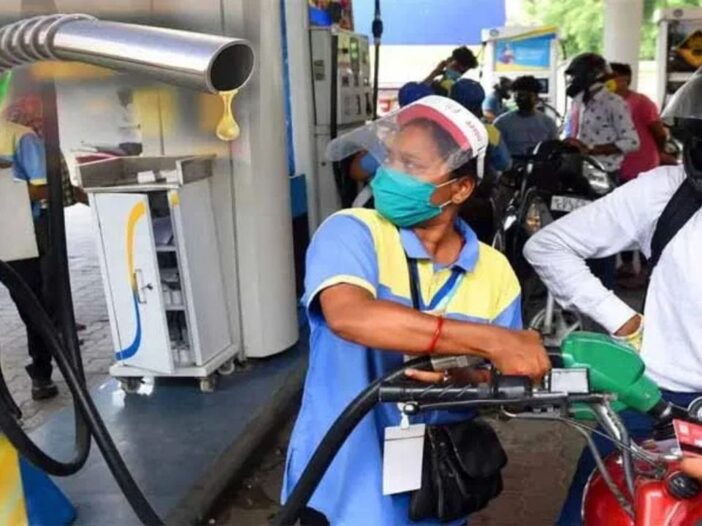
The losses incurred by oil companies (OMCs) on petrol and diesel will stop only when the price of crude oil falls to around $85-87 per barrel. At current pump prices they are still incurring a loss of Rs 7-8 per litre. This loss is despite the recent increase and reduction in duty, which the government is not ready to take back.
Mahesh Nandurkar, top analyst at Jefferies, said in a media report that despite an 8 per cent increase in retail fuel prices, auto fuels “are still being sold at a loss of about Rs 7-8 per litre, and the state oil companies themselves are bearing this loss. This loss reflects the gap between (under-recovery) high international prices and domestic pump prices that are limited for political reasons.”
The special thing is that in March 2026, excise duty on petrol and diesel was reduced by about 40 percent, due to which the problems of the companies have increased even more. Due to which the prices reached the lowest level in 10 years. The report estimates that this reduction will continue in FY 27 also. The central government is not ready to withdraw this relief given to consumers, hence there is very little scope to increase the profits of oil companies again by making changes in tax.
Break-even point of $85-87
According to the Jefferies report, at current retail prices, the break-even point for state-run oil companies will be $85-87 per barrel. Which means that if the price of crude oil is above this range, the companies will remain in loss. According to Jefferies’ original estimate (base case), the price of Brent crude is expected to be $ 90 per barrel from July 2026. This simply means that if prices are not increased further, marketing companies will continue to suffer losses at the pump.
This break-even range is actually the point where the current domestic fuel price and global input costs become equal to each other. Below $85, oil companies can begin to make at least normal marketing profits, while above $87, losses either continue, or a politically difficult price increase is required to restore profits.
Why are oil companies suffering losses?
The fiscal constraints of the central government are the main reason that instead of the budget, oil companies are being used as shock absorbers of economic shocks. Jefferies estimates that higher subsidies on petroleum and fertilizers, as well as lower oil tax revenues (assuming Brent crude price is $90), will impact the central government’s finances by Rs 75,000-90,000 crore, or 20-25 basis points of GDP.
To remain on the path of fiscal strength and achieve the fiscal deficit target of 4.3 per cent of GDP in FY2027, it seems that the government will not relax expenditure nor will it reverse the cut in fuel duty. Analysts caution that we believe this will have to be offset by spending cuts elsewhere — most likely by cuts in non-defense capex — which could result in fiscal 2027 being roughly flat from last year. This also makes it more difficult for New Delhi to directly compensate the oil companies for their losses.
Subsidy, threat of drought and lack of scope
High crude oil prices are already increasing the subsidy bill, limiting the fiscal space to bail out oil companies. The report estimates that at $90 Brent crude price, the cost of fertilizer subsidy could exceed Rs 30,0040,000 crore in FY 2027. There is a reason for this also. The prices of urea have already doubled in the international market and the cost of imported LNG has increased by 4050 percent. LPG subsidy can also increase up to Rs 20,000,000 crore. Jefferies believes that after the recent increase of Rs 60 per cylinder, its impact on consumers will be limited and some of the burden will still have to be borne by the oil marketing companies.
Apart from this, IMD has predicted a weak monsoon, with rainfall expected to be 8 percent less than normal. Due to this, the expenditure on Rural Employment Guarantee Scheme may increase by Rs 10,00020,000 crore. The report argues that “its impact is likely to be on the ‘discretionary pool’ of spending—particularly non-defense capex—rather than through increasing fuel taxes or paying higher compensation to oil companies.
What option does the government have?
Since oil marketing companies (OMCs) are able to break even at a price of $85-87, Jefferies believes that if crude oil prices remain around $90 and the government sticks to its fiscal roadmap, then retail fuel prices will have to increase further from the current level. This would obviously pose political challenges, as petrol and diesel prices in Mumbai had recently fallen just short of their post-Russia-Ukraine war highs of Rs 121 and Rs 105 per litre, respectively, 7-8 per cent higher than current levels.
Along with this, the central government is also resorting to other measures to deal with the oil crisis. It has increased the customs duty on gold and silver by 9 percentage points to 15 percent. Jefferies estimates that this could generate additional revenue of Rs 40,00050,000 crore, while the ‘windfall tax’ imposed on fuel exports is expected to generate another Rs 5,00010,000 crore.
The budget also aims to more than double the receipts from disinvestment as compared to the revised estimates for financial year 2026. This emphasizes that it is necessary to increase non-tax revenue. Until crude oil prices come back to a comfortable range of $85-87, the oil companies themselves will have to bear the burden of expensive crude oil.

Leave a Reply