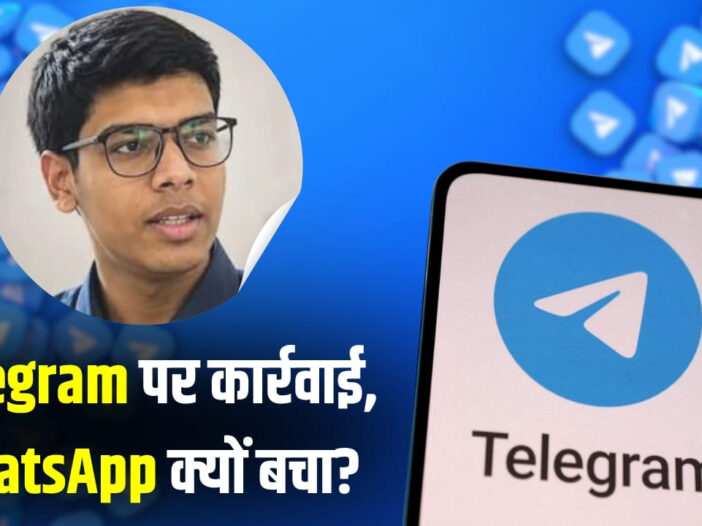
A heated debate has erupted on social media over the decision of the Central Government to temporarily block Telegram before the NEET-UG 2026 re-exam. At the center of this debate are IIT Kanpur director Manindra Aggarwal and student Sarthak Siddhant. Sarthak has raised the question that if Telegram can be shut down due to wrong information, then why the same logic does not apply to WhatsApp also. In response to this, Manindra Aggarwal supported the government’s decision and pointed towards a specific problem of Telegram. Let us tell you that Telegram has been temporarily banned in India till June 22.
Debate started from social media post
After the decision to ban Telegram, 18-year-old student Sarthak Siddhant raised the question on social media that how right is it to shut down a communication platform just because there is wrong information there. Sarthak wrote on X that wrong information is also seen in WhatsApp, then why action was taken only on Telegram. Sarthak Siddhant is the same student who has earlier gained national recognition by exposing alleged irregularities in the CBSE evaluation process and cases related to tender manipulation. After his post, this issue became rapidly discussed and many users also started raising questions on the government’s decision.
just because a communication medium has elements of misinformation, we have decided to shut it down.
~ IITK Director
doesn’t whatsapp have elements of misinformation? doesn’t the indian press? what’s the reasoning behind shutting down entire telegram? https://t.co/yZE1FkcYNe
— Sarthak Sidhant (@sidhant_sarthak) June 16, 2026
Manindra Aggarwal replied, told the real problem
Responding to Sarthak’s post, Manindra Aggarwal, professor and director of IIT Kanpur, said that Telegram’s problem is not only in sharing the alleged paper leaked content. According to him, there are many other ways to share the paper, but Telegram was being used to spread such fake claims which was creating confusion among the students. He said that even during the JEE Advanced exam, some people had used Telegram to pretend that the alleged paper leak was real, thereby spreading unnecessary confusion and rumours. After his reply, the debate intensified and reactions started coming in support of both the parties on social media.
What was the debate between the two on social media?
The debate on Telegram ban intensified when Sarthak Siddhant took a jibe at the social media platform He said that every voice of dissent cannot be suppressed by spreading false information and stopping communication between people is not the solution to any problem.
In response to this, Manindra Aggarwal said that the case of Telegram is different from other social media platforms. According to him, if a user edits a post or message on WhatsApp, it is clearly visible that changes have been made in it. Therefore, it is not easy to create misleading evidence by changing the old message.
Manindra Aggarwal further claimed that there is such a special feature in Telegram, in which even after the post is edited, in many cases it is not clearly visible that changes have been made in it. According to him, this facility can prove dangerous for spreading fake paper leak claims and misleading material. Although he also admitted that there can be debate on whether the ban is the right step or not, but it is important to understand the context behind the decision.
At the same time, Sarthak Siddhant called this claim directly wrong. He said that an indication of an edited message is also visible in Telegram. In support of his argument, he cited Telegram’s open-source code and said that the feature related to showing edit time and date is already present in the platform. Sarthak said that wrong information is being presented regarding the technical system of Telegram and it is not appropriate to target the entire platform on this basis.
After all, why did the government ban Telegram?
On the recommendation of the National Testing Agency i.e. NTA, the Central Government has temporarily stopped the access of Telegram in the entire country till June 22, 2026. NEET-UG 2026 re-exam is to be held on June 21 and NTA says that many Telegram channels were openly claiming to provide alleged question papers by taking money from students and parents. According to the agency, channels with names like “Paper Leaked NEET”, “Re-NEET 2026” and “Private Mafia” were demanding money ranging from thousands to lakhs of rupees. NTA clearly said that no question paper of the examination is available outside the secure process and all such claims are completely fake. According to the agency, this step was taken as the last option.
The main reason behind imposing a temporary ban on Telegram is some of its features, which are allegedly used more by fake paper leak and fraud networks. On Telegram, users can hide their phone numbers and work only through usernames, making it difficult to trace the identity of channel operators. Apart from this, channels with millions of subscribers can be created without any limit and large files up to 2GB can be shared easily.
According to NTA, some channel administrators used to edit old messages and later add PDF or other content with the same timestamp, thereby creating fake evidence of paper leak. This is the reason why the edit feature of Telegram has also been temporarily closed in India.
At the same time, the time limit for editing messages on WhatsApp is limited and there is no facility to add files later. Additionally, Meta also monitors suspicious activities and public groups with the help of its AI system. WhatsApp takes relatively quick action on government instructions, whereas due to Telegram’s structure and operating system, action in such cases is considered more challenging.
Also read: Sarvam AI gets $234 million funding, India’s AI ecosystem will get a boost

Leave a Reply