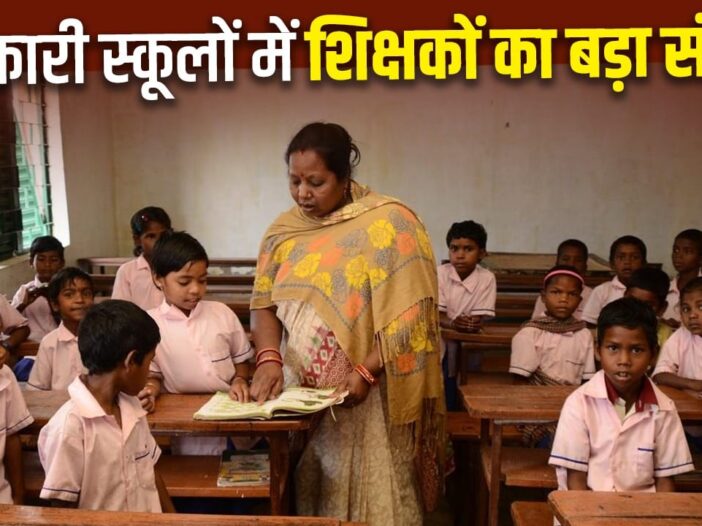
The aim is to provide quality education to every child under the New Education Policy (NEP) and Right to Education (RTE) Act in the country. But the Education Ministry’s reply to MP Randeep Surjewala’s question in the Rajya Sabha on July 29 tells a different story. According to the Education Ministry, during 2025-26, there are 1,00,843 such schools in the country, where there is only one teacher to manage the entire school. This clearly means that the education of lakhs of children is going on through only one teacher.
At the same time, according to the report of NITI Aayog, 94,000 government schools have been closed in India in the last decade, due to which the enrollment of children has decreased by 2.26 crores. The number of government schools has decreased from 11.07 lakh to 10.13 lakh, while the number of private schools has increased.
What are single teacher schools?
Where there is only one teacher to manage the entire school, it is called single teacher school. A single teacher does the entire work including teaching all the classes, recording the attendance of children, monitoring mid-day meals, administrative work and implementation of government schemes. If that teacher goes on leave or gets involved in some work under training or any other government orders, then school education is badly affected.
More than 1 lakh schools, and the burden of the entire school is on the shoulders of just ‘one teacher’!
Just imagine the picture of the government school in that village – where there is only one master. He marks the attendance from class 1st to 5th, he teaches mathematics, science and Hindi, he keeps track of mid-day meals and works as a postman to send papers. pic.twitter.com/XYjg5r5vm4
— Randeep Singh Surjewala (@rssurjewala) July 29, 2026
How many such schools are there in the country?
Based on the data of UDISE+ 2025-26, the Education Ministry said that there are 1,00,843 single teacher schools in the entire country. Andhra Pradesh ranks first among the states with the highest number of single teachers. Then come states like Jharkhand, Maharashtra, Karnataka and Uttar Pradesh. The number of single teacher schools is less in Andaman and Nicobar, 7 in Delhi, 28 in Ladakh, 31 in Sikkim, 35 in Nagaland and 67 in Kerala.
States with the highest number of single teacher schools?
- Andhra Pradesh 16,357
- Jharkhand 9,827
- Maharashtra 9,269
- Karnataka 8,042
- Uttar Pradesh 7,874
- Rajasthan 7,200
- West Bengal 6,769
- Telangana 4,793
- Tamil Nadu 3,957
- Assam 3,159

What are the reasons behind having a single teacher school?
The Education Ministry says that there are many reasons behind this happening. Retirement of teachers, resignation, non-creation of new posts on time, delay in recruitment process, non-reappointment of teachers as per the number of students. Challenge of appointment in remote, tribal and rural areas. The Ministry of Education also says that the responsibility related to recruitment, posting and service of teachers in government schools mainly lies with the state governments and union territories and not with the Government of India.
What problems arise due to single teacher school?
- Not every child gets enough time in a multigrade classroom.
- The quality of studies may decrease. Children may be weak in studies
- Teaching time is reduced due to administrative work.
- Mental and workload pressure on the teacher increases
What is the student-teacher ratio in the country?
In the National Education Policy (NEP) 2020, it was clearly mentioned that there should be adequate teachers in every school. It aims to maintain a student-teacher ratio (PTR) of 30:1 in general areas. At the same time, in socially and economically deprived areas this ratio should be 25:1. The Education Ministry said that according to UDISE+ 2025-26, the student-teacher ratio at the national level is within the prescribed standards.
- Primary level- 19:1
- Upper Primary- 17:1
- Secondary- 15:1
- Higher Secondary – 23:1
At present, the national average of student-teacher ratio seems better, but the number of single teacher schools indicates otherwise. This clearly means that the average figures are not fully reflecting the local problems.
What is the government doing to tackle the challenge of single teacher schools?
The Education Ministry told in Parliament that the Central Government from time to time advises the states and union territories to fill the vacant posts. Apart from this, according to the Ministry of Education, it is emphasizing on transparent and merit based teacher recruitment. The recruitment process is being regularly reviewed. Technology based assessment of teacher needs is being done. Financial assistance is being given to the states under the Samagra Shiksha Yojana. Emphasis is being laid on maintaining student-teacher ratio as per RTE law. NISHTHA program is being run for the training of teachers. Apart from this, digital training and e-content are being provided through DIKSHA platform.
Will the problem end only by recruiting teachers?
- Deployment of teachers as per need
- Incentive for service in remote areas
- timely recruitment
- Expansion of basic facilities in schools
- Emphasis on digital education
Why is it difficult to achieve the goals of the new education policy in these circumstances?
Despite continuous efforts to reform the education system in India, more than one lakh single teacher schools show that teacher availability at the grassroots level still remains a major challenge. The goals of the new education policy cannot be achieved through the current circumstances. For children to get quality education, local challenges like single teacher schools will have to be overcome.

Leave a Reply