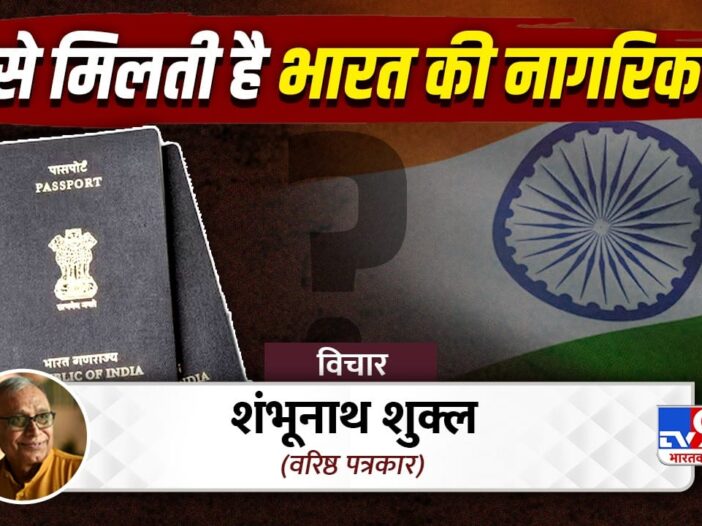
Indian Citizenship Proof: The Ministry of External Affairs made it clear on Wednesday that the passport holder cannot be considered a citizen of India. According to the spokesperson, passport is only a proof of a person’s travel document and not of his citizenship. Now a new debate has arisen as to what will be the basis for proving citizenship? Because Aadhaar certificate and Voter ID card are also not considered as evidence to prove someone’s citizenship. This is just proof of his address.
The government’s argument is that if a person was born in India after 26 January 1950 or his parents were born in India, then this is the proof of his citizenship. But the Ministry of External Affairs forgets that when a person goes to get a passport made, along with his school certificate, his parents’ names, addresses and proof of birth are asked for. Then why this controversy?
Aadhaar, PAN and voter card are also not proof
By the way, in Section 3 of the Citizenship Act 1955, the Indian passport was considered the most solid basis of citizenship. But now it is being rejected. Anyway, police investigation is mandatory before issuance or renewal of passport. It is mandatory for a person wishing to get a passport to remain at home when any police personnel arrives from the local police station. Only then is the police investigation considered complete. It is clearly stated in the Passport Act 1967 that passports can be issued only to Indian citizens. If Aadhar Card, PAN Card and Voter ID Card are not considered as proof of citizenship then what certificate will a man present? As far as birth certificate or school certificate is concerned, all these have to be submitted while making the card. Now Aadhaar, PAN and Voter ID card are not being considered as proof of name in the voter list.
Benefits of schemes only through ration card
The government has clearly said that PAN card is the proof that the person is paying his taxes in India. Passport only shows which countries the holder has visited. Then what is the proof that the person is a citizen of India? This matter has now become so complicated that it is possible that any government official or member of the legislature may come under suspicion regarding his citizenship. It has also been clearly said about the ration card that the holder of this card is entitled to get the benefits of the welfare schemes of the government. The question arises that if someone is taking advantage of the government’s welfare schemes but does not get the citizenship card, then are we wasting our money to foreigners? Our tax money is being distributed among foreigners.
The benefit of OCI is not available to Indians who went before independence.
The laws for obtaining citizenship in India have been very strict since the beginning. There is no provision for dual citizenship here. The Government of India issues an Overseas Citizen Card (OCI) card to Indians who have given up their Indian passport after obtaining citizenship abroad, on the basis of which they can stay in India. One can do any business, can also buy or sell property. Not only can they not get a government job and can’t vote, but if a Non-Resident Indian (NRI) wants to get Indian citizenship again, then he will have to stay in India and wait for seven years. Interestingly, the Indians who left India and settled abroad in the 19th and first half of the 20th century do not have the facility of OCI. For this reason, lakhs of indentured laborers cannot return to their roots despite being of Hindu and Indian origin. They have to face all kinds of difficulties in getting Indian visa.
Formation of Pakistan created confusion
In a release issued on 20 December 2019, the government had said that if a person can get his name registered in the Natal Register of Citizens (NRC) by submitting any document related to his date of birth and his place of birth. But no final decision has been taken on this yet. In 1955, when the issue of citizenship was raised in India, the government had clearly said that anyone who was born in India after 26 January 1950 would be considered an Indian citizen. In this way, all those who were born in India during this period got Indian citizenship. But till 1960, uninterrupted movement continued between India and Pakistan. Due to this, many people of Pakistan also got Indian citizenship. When East Pakistan became Bangladesh and people from there started coming to India, he would have taken advantage of this facility.
One of the parents must be an Indian
For this reason, the Government of India made a new rule in 1986 that in future, only those who were born in India between January 1, 1950 and July 1, 1987 would be granted Indian citizenship. In the matter of granting citizenship to people born in India after July 1, 1987, it was also said that their mother or father must have Indian citizenship. In the year 2003, another amendment was made in the Citizenship Act that only those people born after December 3, 2004, whose parents are not illegal immigrants in India, will be given citizenship. To obtain citizenship in India, one’s date of birth, place of birth and lineage became more important. Despite such complex rules, illegal migration could not be stopped in India. Now it has come to light that some people also obtained Indian passport on the basis of fake documents.
It is not easy to get a passport
Therefore, the Ministry of External Affairs said on Passport Day on Wednesday that the passport tells the travel data of a person, it is not the proof of his being an Indian citizen, but this is where the question arises that getting a passport in India is a very complex process, then how does it get manipulated. In the Citizenship Act 1955, various types of Indian citizenship have been considered in sections three to five. Like accepting citizenship on the basis of lineage, birth, registration. Apart from this, if any foreign ruled territory joins India then its residents will naturally be considered citizens of India. Like French ruled Puducherry and Portuguese ruled Goa, Daman and Diu and later when Sikkim was acquired, the citizens there were automatically considered Indian citizens. The Portuguese gave freedom to the people of the area under their control by giving them Portuguese citizenship.
Portuguese PM was also from India!
Because of this, the people of Goa, Daman and Diu could become Portuguese citizens as per their wish. When Portugal joined the European Union, such people automatically started moving freely to the European Union countries. The Government of India gives OCI to such people. You might remember that recently when a European Union delegation had come to India, the European Council President Antonio Costa had also shown his Indian passport to the press. Actually it was OCI card, which must have been issued by the Government of India. Costa has also been the Prime Minister of Portugal before 2024. Costa is of Indian origin. On one hand, it is very difficult to obtain Indian citizenship and on the other hand, it is equally easy for Indians settled abroad to obtain OCI. Therefore, the Government of India should issue a document which is a solid proof of citizenship.
must complete the process
However, this confusion lies with those who are indifferent towards obtaining such a document themselves. Such situation is less in villages. The written certificate of the village head is also considered as a document as proof of birth. In cities, the area councilor has the authority to issue such a certificate. Apart from this, any magistrate can get that evidence examined. Any person can ask for citizenship certificate through the Indian Citizenship Portal. The District Magistrate will investigate the facts presented by him and an officer of the level of Under Secretary in the Home Ministry will issue his citizenship certificate.

Leave a Reply