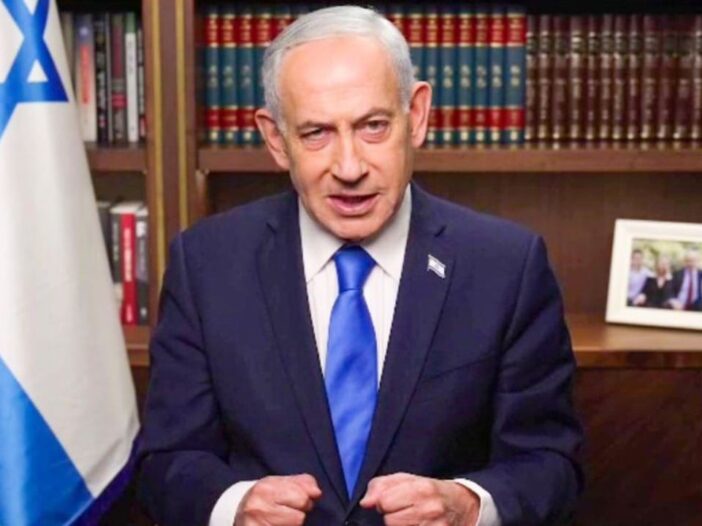
Israeli Prime Minister Benjamin Netanyahu has broken his silence after US President Donald Trump announced the ceasefire. Netanyahu said that if Hezbollah does not stop its offensive against northern Israel, his country will carry out its pre-planned strategy to target Beirut. In fact, this warning from Netanyahu comes after the statement given by US President Trump, in which he said that Israel Defense Forces (IDF) will not enter the Lebanese capital and both sides will stay away from mutual hostility, which indicates that both the groups have committed to a temporary active ceasefire.
“I spoke to President Trump and told him that if Hezbollah does not stop attacks on our cities and civilians, Israel will attack terrorist targets in Beirut,” Netanyahu clarified in a statement in Hebrew, defending the country’s military position.
The Israeli leader emphasized that diplomatic talks will not hinder the military exercises going on at the front. The IDF will continue its operations in southern Lebanon as planned, he said. The exact parameters of the temporary ceasefire made public by Trump still remain unclear, as there are conflicting signals from Washington, Jerusalem, Hezbollah and Beirut.
Netanyahu’s official response was issued about two hours after Trump publicly announced the ceasefire, lending credence to the assessment that the diplomatic agreement was brokered by the Washington administration under intense pressure on Jerusalem.
The dramatic public tensions came as the Israeli leadership ordered military action targeting areas south of Beirut and vowed to intensify operations against Hezbollah. Giving information about the sudden diplomatic change after this, Trump said on his social media platform, I had a very productive conversation with Israeli Prime Minister Netanyahu and no army will be sent to Beirut.
He further said that military units moving towards the Lebanese capital have been ordered to retreat. The US leader also claimed that Hezbollah has agreed to end hostilities through alternative diplomatic channels. He said that similarly – I had very good talks with Hezbollah through high-ranking representatives and they agreed that all firing would stop. Israel will not attack them and they will not attack Israel.
However, given the deep roots of the conflict, the long-term sustainability of this ceasefire remains completely uncertain. For a long time, the Lebanese nation has been caught between geopolitical rivalries, which initially started after a joint agreement. Iranian bases were targeted in the American-Israeli military attack. Since then, instability has been increasing in Lebanon’s southern regions, forcing thousands of families living on the southern outskirts of Beirut to flee their homes in response to Israeli displacement advisories.
Given these dire circumstances, the US President’s diplomatic maneuvering took on greater importance than actual military planning. According to Israeli press reports, the planned bombing across Beirut was postponed after a direct appeal from Washington.
Regional media reports suggest the US urged Israel to halt its operations to pursue a diplomatic ceasefire outline, despite earlier indications that Israel’s strategic military roadmap was in line with US officials. Nevertheless, this temporary pause in fighting leaves the core ideological and territorial disputes completely unresolved. The current Israeli administration says Hezbollah’s military presence near the northern border cannot be tolerated, while the Lebanese group, on the other hand, continues to establish itself as a key component of the Iran-backed regional network.
This rising regional tension has also disrupted direct diplomatic channels between Washington and Tehran. Iranian media outlets revealed that his administration halted active diplomatic relations with the US as a direct response to the military operation in Lebanon, claiming that the incursion directly undermined the existing ceasefire.
At the same time, the US President has presented contradictory views regarding the state of diplomatic relations with Tehran. Shortly before announcing the breakthrough between Israel and Lebanon, he mentioned that he had not received any prior information about diplomatic relations. Regarding the stance taken by Iran, the Republican leader expressed no concern about a possible impasse in talks with the Iranian government, saying he would be perfectly content to bide his time.
However, just minutes later, he changed his stance again and added more complexity to the rapidly changing diplomatic landscape by sharing in a Truth Social post that negotiations with the Islamic Republic of Iran are continuing at a rapid pace.

Leave a Reply