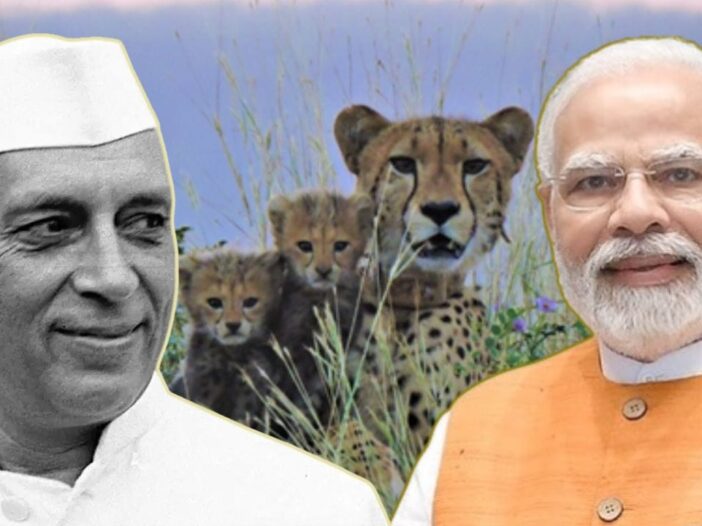
The stories of leopards are woven into old stories in the country. Asiatic leopards, which once roamed without fear from the Arabian Peninsula to the Indian subcontinent, became extinct in independent India. This resulted in desolation in the grassland-savanna biome. Earlier, Asiatic leopards were seen in different open spaces across India from Punjab in the north to Tirunelveli in Tamil Nadu and from Gujarat and Rajasthan in the west to Bengal in the east. This included scrub forests, dry grasslands, savannas and other arid to semi-arid areas.
Wild leopards were last seen in the country in 1947, when three animals were shot in the Sal forests of Koriya district in present-day Chhattisgarh. Five years later, in 1952, this species was officially declared extinct in India. India’s native Asiatic cheetah became extinct due to overhunting, poaching and the use of cheetahs for corsaging.
Kuno becomes the new home of cheetah
Extensive habitat loss due to farming, loss of prey, climate pressures, and the species’ low regeneration rate and low genetic base accelerated their extinction. Kuno was selected as the best reintroduction site after the relocation of 24 villages (1,545 families) with the support of an expert committee. With this, about 6,258 hectares of grasslands were created for leopards.
Encouraged by the Convention on Biological Diversity (CBD)’s strategies for species recovery by 2022, India translated this plan into action. The objective of this project is in line with UN Sustainable Development Goal 15 (Life on Land), making India a leader in reversing biodiversity loss through transboundary conservation.
One September morning in 2022, eight majestic cheetahs set foot on Indian soil from the Namibian Savanna. These were the first steps of a species that had been missing from the subcontinent for a long time. This historic moment, chaired by Prime Minister Narendra Modi at Kuno National Park in Madhya Pradesh, marked the beginning of Project Cheetah, the world’s first intercontinental translocation of a large carnivore.
November 2025 and Mukhi’s clan
By November 2025, the first Cheetah Mukhi born in India has herself become the mother of five healthy children. It is not only a symbol of biological resurgence, but also a testament to human management of the delicate balance of nature. Project Cheetah, launched on 17 September 2022 under the supervision of the Ministry of Environment, Forest and Climate Change and led by the National Tiger Conservation Authority (NTCA), is a symbol of India’s unwavering commitment towards the restoration of biodiversity.
Based on the 2013 action plan and Supreme Court directions, it calls for the reintroduction of the Asiatic leopard (Acinonyx jubatus, which was declared extinct in India in 1952) as an endangered species to promote ecosystem health across vast landscapes. As of December 2025, there are 30 leopards in Kuno.
With eight more cheetahs arriving in India from Botswana, the project remains a ray of hope and has received international praise for its scientific labor and diplomatic skills. What started as a conservation experiment has become a statement of ecological hope and the country’s commitment. Prime Minister Modi’s vision and continuous encouragement has been the driving force behind Project Cheetah, turning a decades-old dream into a living reality.
PM Modi continuously monitored
From creating the 2022 Action Plan and leading the world’s first intercontinental cheetah translocation, to personally releasing the first eight Namibian cheetahs into Kuno National Park on 17 September 2022, he has been fully involved every step of the way. He signed high-level MoUs with Namibia (July 2022) and South Africa (January 2023), engaged the country through Mann Ki Baat by inviting people to name the leopards, and consistently highlighted achievements like the birth of the first Indian cubs in 2023 and the birth of the historic second generation of cubs in November 2025. There are a total of 30 leopards in the country by December 2025. 12 big, 9 small and 9 cubs, including 11 founder stock and 19 India-born cheetahs.
By linking Mission Life and India’s G20 vision of One Earth, One Family, One Future, Prime Minister Modi has made Project Cheetah a global icon of science-driven, community-inclusive rewilding, personally monitoring its progress and ensuring that the roar of the cheetah, which has been silent in India for seven decades, once again echoes in its pristine grasslands.

Leave a Reply