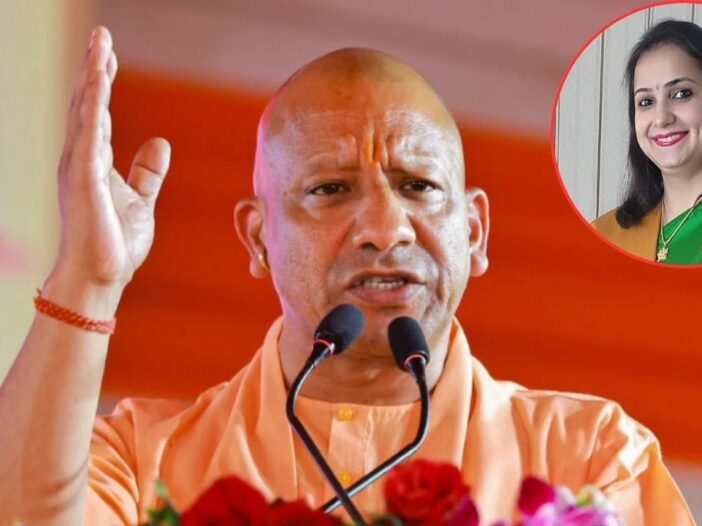
What can be most important for any state? This is a serious question and people will answer it differently at their own level. But, if the reference is to Uttar Pradesh, the correct answer is – Vision. It is important to have a clear vision for the development of any state. If this is not the case, resources get scattered, energy is not utilized properly and goals remain incomplete. In 2017, when Yogi Adityanath, a saffron ascetic, took over the reins of Uttar Pradesh, everyone from the corporate world had only one question in their minds that would he be able to take the state on the path of development?
A state which is full of mafia and criminals, investors are afraid of coming and which is known as BIMARU. It was natural for this question to arise in the minds of people because the foundations of the state were shaken at the management level. Only proper management could answer people’s questions and if the time since then has become an example of this then it will be followed by Chief Minister Yogi Adityanath Had a clear vision.
Perfect execution of vision
One sentence is very common in the corporate world – the manager does the right work, the leader gets the right work done. It was Yogi Adityanath’s managerial vision that he first decided to do the right thing and insisted on doing it in the right way. The basic principle is that the rule of law is the path to development. This was his strategic manifesto, which gave a direction and an objective to the entire administrative system. Along with this, a criterion was also laid down by which every policy, every decision and every officer can be tested.
If there is such clarity in the vision, the edge of execution automatically becomes sharper. In the last nine years, the great story of inclusive development, world-class events and investment proposals worth Rs 50 lakh crore came only from the correct execution of the vision. That is why Yogi is today seen as a management guru whose decisions are of interest to management institutes and students as case studies.

Pro. Deepti Taneja (Department of Economics, Delhi University)
Zero tolerance becomes brand positioning tool
The aim of the Yogi government was to revive the ailing state. In the corporate world this process is called ‘turnaround’. This process was not easy. From uprooting old roots to breaking old administrative structures. Those people also had to change, who were living in the mentality of ‘this is what has been happening’ for years. The situation before 2017 was similar, in which the entire system had become stagnant. There was no accountability and no culture.
Uttar Pradesh was known as ‘Danga Pradesh’ and it was not just an image, it was a curse that was forcing the youth to migrate and stopping the entrepreneurs from coming. In such a situation, the state could have a distinct identity only when the entire system was completely changed and the state was made a brand.
For this, Yogi Adityanath used the ‘zero tolerance’ policy as a ‘brand positioning tool’. While bulldozers broke the morale of criminals, the campaign against mafia gave a direct message that the law is equal for everyone. The strict implementation of this decision gave a clear ‘marketing signal’ to the country’s industry that Uttar Pradesh is changing. The result came in the form of a huge surge in revenue and today Uttar Pradesh is moving towards becoming the second largest economy of the country, so this is the result of the success of the management model here.
efficient CEO style
In management, execution is more important than vision and branding. Personal monitoring and unwavering commitment to deadlines. Daily monitoring of every project, dashboard review and late night review meetings with the Chief Minister himself, seems to be the working style of an efficient and hardworking CEO of a startup. When the person at the top is himself accountable, the entire system becomes accountable. The Mahakumbh of 2025 was the biggest and most visible proof of the capability of this execution.
The coming together of more than 66 crore devotees at one place was the largest experiment in logistics and crowd management in human history. Transport, security, health, sanitation, digital services, running every department together in one rhythm is possible only when ‘Centralized Command and Control’ is alive in practice. The success of Mahakumbh created such a history of management that even experts from Harvard University came running to it.
Blue Ocean Strategy
There is another aspect which is impossible to ignore – Blue Ocean Strategy. In this strategy, you go out of competition and create a new and untouched market, where there is no rival. While all states were adopting similar policies, Uttar Pradesh introduced innovations like ‘One District, One Product’ (ODOP) and later ‘One District, One Cuisine’ (ODOC). ODOP became a major pillar for the state’s economy. This policy not only provided livelihood to lakhs of artisans but also gave them an identity and this is the essence of the ‘HR Policy’ of any successful organization.
UP model became the subject of research
The real test of management is in any serious crisis. Uttar Pradesh gave this examination twice during the Covid wave. Lack of oxygen, limitations of health infrastructure and the responsibility of millions of lives, the administrative response that came in the form of ‘Integrated Covid Command Centre’. District level monitoring, real-time tracking of oxygen distribution, availability of medicines, all this was an extension of the same ‘dashboard governance’ that has become the hallmark of this government.
Uttar Pradesh’s change is a big story of management and that is why today IIM researchers are writing research papers on ‘UP Model’ and Uttar Pradesh is being discussed in Harvard Business Review. This is not normal for any state. The CEO look of a Sanyasi in saffron clothes is impressing everyone. Yogi has proved that leadership has no dress nor does it have any background at its core. If the commitment towards the public is sincere, then even a monk emerging from the monastery can become the most successful ‘turnaround CEO’ of the country’s most populous state.
-Pro. Deepti Taneja
Department of Economics, Delhi University

Leave a Reply