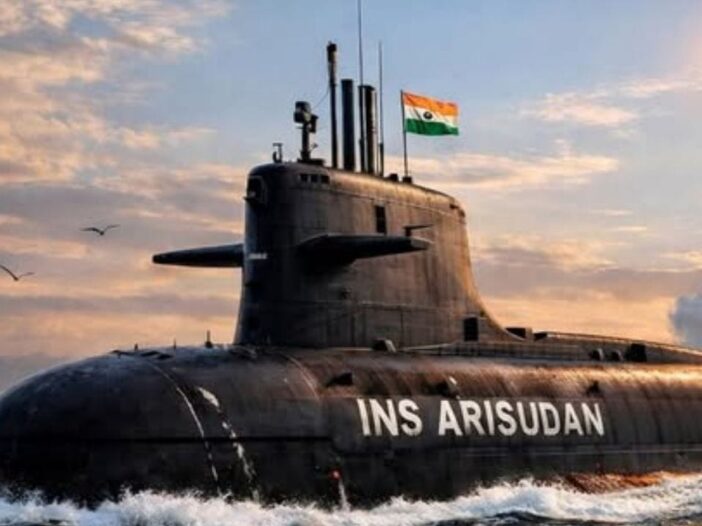
India has achieved another major achievement in its indigenous nuclear submarine program. Advanced sea trials of the fourth and final Arihant-class nuclear ballistic missile submarine S4* have been launched. According to sources, this nuclear submarine will be formally named INS Arisudan. This submarine is currently undergoing sea trials and will be inducted into the Indian Navy by the year 2027.
Arisudan means destroyer of enemies. This naming convention has been maintained like the earlier submarines INS Arihant, INS Arighat and INS Aridhaman.
1. Advanced stage of Sea Trials
Having been launched from the Ship Building Center (SBC) in Visakhapatnam in the last week of December 2025, INS Arisudan is currently undergoing its advanced sea trials in the deep sea. According to sources, testing of its propulsion, radar and sonar systems has started on strict standards. This trial process is expected to last for about a year.
2. Preparation for commissioning in early 2027
According to sources, INS Arisudan will be formally commissioned into the Indian Navy by the beginning of 2027 (or by the end of 2026). After the recent induction of India’s third nuclear submarine, INS Aridhaman (S4) into the fleet secretly in April 2026, the entire focus is now on this fourth submarine.
3. Goal of ‘Continuous At-Sea Deterrence’ (CASD)
The arrival of INS Arisudan in the Navy is going to prove to be a game-changer for India. When India will have 4 nuclear submarines (Arihant, Arighaat, Aridhaman and Arisudan), then India will achieve the status of Continuous At-Sea Deterrent (CASD). This means that at least one nuclear submarine of India, equipped with nuclear missiles, will be on patrol in the depths of the sea at all times, while the remaining submarines will be in repair, maintenance or training rotation.
Strengths and features of INS Arisudan
- This submarine is much more lethal and larger than its initial sisters (Arihant and Arighaat).
- Arihant-Stretch’ design: It is about 10 meters longer than INS Arihant, due to which its weight has increased to about 7,000 tonnes.
- Double the firepower: It has 8 missile tubes of the Vertical Launch System (VLS) (early submarines had only 4). It is capable of carrying 8 lethal K-4 missiles (range: 3,500 km) or 24 K-15 Sagarika missiles (range: 750 km) simultaneously.
- More than 80% indigenous: More than 80% of the components in this submarine are completely made-in-India, which is the biggest example of India’s self-reliance.
- Next-Gen Reactor: It has an upgraded 83 MW compact light-water reactor, whose ‘acoustic signature’ (noise) is very low. Due to this, it will be almost impossible for the enemy’s sonar to find it in the depths of the sea.
- This submarine will also prove to be an important base for the more advanced S5-class nuclear submarines to come in the future.
According to sources, as soon as its sea-trials are completed, it can make INS Varsha, a highly secure and secret naval base being built near Visakhapatnam, as its permanent homeport.

Leave a Reply