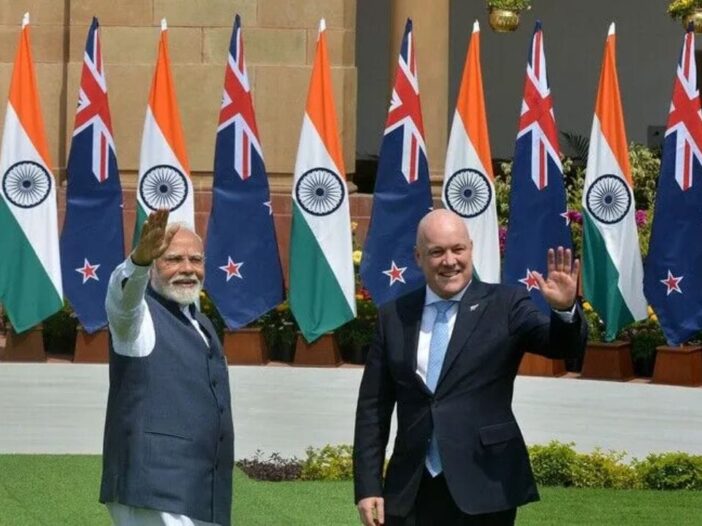
Prime Minister Narendra Modi reached New Zealand on the last leg of his six-day tour. Prime Minister Christopher Luxon welcomed him at Government House in Auckland. During this, PM Modi was given a guard of honour. After the welcome ceremony, bilateral talks took place between the two leaders. During this, major issues like trade, investment, defense cooperation, Indo-Pacific region, agricultural technology (Agri-Tech), sports, education, tourism, culture, economic partnership and increasing people-to-people contacts were discussed. PM Modi also invited Prime Minister Christopher Luxon to visit India.
India and New Zealand agreed to elevate their relations to the level of Strategic Partnership. Both countries reiterated their commitment to strengthen cooperation in all areas of common interest. During this, emphasis was laid on early implementation of India-New Zealand Free Trade Agreement (FTA). Both the countries set a target of doubling bilateral trade by 2030.
Signing of 10 important agreements
During Prime Minister Narendra Modi’s visit to New Zealand, India and New Zealand announced to elevate their relations to strategic partnership. Both the countries signed 10 important agreements in many areas including defence, maritime security, anti-terrorism, tourism, dairy, sports, culture and education. Also, a target was set to double the trade between the two countries to 7 billion New Zealand dollars (about Rs 35 thousand crore) by 2030.
Emphasis on maritime security and defense cooperation
In the agreements signed in the presence of Prime Minister Modi and New Zealand Prime Minister Christopher Luxon, the biggest emphasis was on maritime security and defense cooperation in the Indo-Pacific. For the first time, Maritime Cooperation Arrangement and Mutual Logistics Support Arrangement were agreed between the two countries. Under this, the Indian Navy and New Zealand Defense Force will be able to provide logistical support to each other. It was also decided to start regular dialogue on maritime security.
This has been a great year for the India-New Zealand partnership. Earlier this year, our nations concluded a Free Trade Agreement in record time and now, we have elevated our ties to a Strategic Partnership. Next up, we wish to double bilateral trade by 2030! https://t.co/IyR5qpUt2X
— Narendra Modi (@narendramodi) July 11, 2026
Target to double bilateral trade by 2030
To increase cooperation against terrorism, both the countries have decided to form a Joint Working Group on Counter Terrorism. Through this, coordination on intelligence sharing and anti-terrorism strategy will be increased. To promote trade and investment, both the countries have set a target of doubling bilateral trade by 2030 under the Free Trade Agreement (FTA). The government believes that this will provide new markets to the industries of both the countries and increase investment.
Many important decisions in agriculture sector
Many important decisions were also taken in the agriculture sector. India and New Zealand have announced the launch of Kiwi Fruit Action Plan. Under this, two centers of excellence will be established in Uttarakhand and Nagaland. It has also been agreed to increase technical cooperation in animal husbandry and dairy sector.
In the field of disaster management, an agreement has been signed between the National Disaster Management Authority (NDMA) of India and the National Emergency Management Agency (NEMA) of New Zealand. Both countries will share experience and technology to deal with earthquakes, tsunamis and coastal disasters.
Important agreements in the field of education and research
Two important agreements have also been signed in the field of education and research. The Goa-based National Center for Polar and Ocean Research and the University of Canterbury will work together in Antarctica research. An agreement has been reached between NIFTEM and Massey University regarding food technology, research and student exchange.
New Zealand has also announced to join the Global Biofuels Alliance. Apart from this, New Zealand will also cooperate in the development of the National Maritime Heritage Complex located in Lothal, Gujarat.
big decisions
- India-New Zealand relations upgraded to strategic partnership.
- Three big agreements on defense and maritime security.
- A joint working group will be formed on terrorism.
- Target of NZ$7 billion trade by 2030.
- Kiwifruit Center of Excellence in Uttarakhand and Nagaland.
- New Zealand will join the Global Biofuels Alliance.
- Cooperation in Antarctica research and food technology will increase.
- Regional and global issues were discussed and consensus was reached to increase cooperation on multilateral platforms.
- Many MoUs and agreements were exchanged in the presence of both the Prime Ministers.
- These agreements are related to defense and maritime security, hydrography, sports, disaster management, dairy, tourism, maritime heritage, culture, food technology and marine research.
India-New Zealand Free Trade Agreement
Prime Minister Narendra Modi along with New Zealand PM Christopher Luxon interacted with selected CEOs and business leaders. PM Modi said that India and New Zealand are linked by shared principles of democratic values, rule of law, diversity and sustainable development, which are the foundation of a strong economic partnership. The PM described the India-New Zealand Free Trade Agreement (FTA) as a historic step for the economic relations between the two countries. He said that FTA will open new opportunities for market access, investment, services, technology and talent mobility.
PM Modi described India’s rapid economic growth, young and skilled workforce, growing middle class, digital revolution, modern infrastructure and economic reforms as big investment opportunities. He said that India’s political stability and continuous development are making it an important engine of global economic growth.
PM Modi invited for investment
PM Modi invited New Zealand investors to invest in infrastructure, civil aviation, logistics, clean energy, urban transport, water management, waste management and digital economy. Referring to India’s startup ecosystem, he called for increased collaboration between the private sector in innovation, fintech and emerging technology. He said that by combining New Zealand’s expertise in dairy science, horticulture and forestry and India’s huge consumer market, food parks and agri-tech capacity, the global food value chain can be developed.
Both countries reiterated the goal of doubling bilateral trade to NZ$7 billion (approximately ₹35,000 crore) by 2030. PM Modi said that India-New Zealand economic partnership can become a global model of inclusive and sustainable trade, which will promote innovation and prosperity.
condemnation of terrorism
India-New Zealand issued a joint statement. During this, both the Prime Ministers strongly condemned all forms and methods of terrorism, including cross-border terrorism. He also condemned the Pahalgam terrorist attack and the terrorist incident near the Red Fort. He talked about zero-tolerance towards terrorism and adopting a consistent attitude. Along with this, he called for dismantling the networks and safe havens of terrorism funding, breaking the infrastructure of terrorism including online and quickly punishing the terrorists.
united against terrorism
The two leaders agreed to enhance cooperation in combating terrorism and violent extremism. They also welcomed the signing of an Agreement (MoA) to create a Counter-Terrorism Joint Working Group (JWG), which will create a framework for sharing information and knowledge. Both the leaders reiterated their resolve to increase cooperation in multilateral fora such as the United Nations (UN) and the Financial Action Task Force (FATF).
The two leaders stressed the urgent need for all countries to take concrete action against UN-proscribed terrorist organizations and individuals – including UNSC 1267 Sanctions Committee-listed organizations and individuals, and their affiliates, proxies, sponsors, financiers and supporters.

Leave a Reply