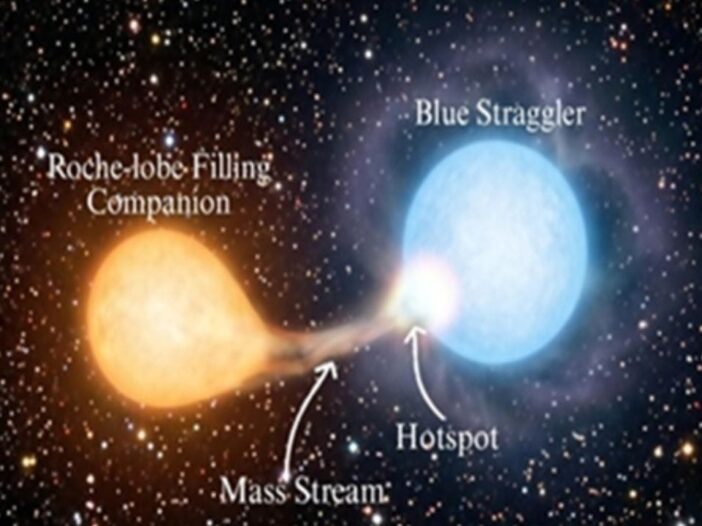
Indian astronomers have achieved a major success. Along with his international colleagues, he has discovered a rare ‘Blue Straggler Star’ (BSS). Which is being built now. This has provided direct evidence of the process of formation of stars. This helps in understanding how these unique stars are formed.
‘Blue straggler stars’ are stars that appear hotter, more luminous and more massive (more massive) than other stars in the same cluster. The ‘Blue Straggler Star’ (BSS) discovery is one of the strongest pieces of evidence yet to understand the formation and evolution of these unusual stars.
How do stars come back to life?
The Ministry of Science and Technology said that astronomers have been trying to understand their origin and evolution for a long time. The ministry said these stars gain mass from a companion star or through a stellar merger, effectively reviving them. Direct observational evidence of such formation processes is quite rare.
Astronomers discover an actively forming luminous blue straggler star
✶Indian astronomers, with international collaborators, have discovered a Blue Straggler Star (BSS) in the process of forming, providing rare direct evidence of how these unusual stars are created.
✶Blue pic.twitter.com/MpZKHsPFog
— PIB India (@PIB_India) July 27, 2026
Scientists studied
To investigate this, scientists from the Indian Institute of Astrophysics (IIA), an autonomous institute of the Department of Science and Technology (DST), conducted a study. Researchers studied the binary star system TIC 327546480, located in the old open star cluster Collinder 261, located about 9,500 light years away.
What are blue straggler stars like?
Blue stragglers are stars that appear hotter, brighter, and more massive than other stars in their group. According to scientists, these stars start appearing young again due to acquiring material from a companion star or due to stellar merger. In this new discovery, scientists found that the Blue Straggler is continuously acquiring material from its low-mass companion star. Due to this process the mass of the star is increasing and its rejuvenation continues.
Intense X-ray emission also detected
The researchers analyzed high-precision light curves from NASA’s TESS space mission and radial velocity data from the European Southern Observatory’s (ESO) Very Large Telescope in Chile. During the study, scientists also detected intense X-ray emissions from this system. This indicates that matter transferred from the companion star is constantly being absorbed by the blue straggler.
Estimated age of the star cluster
According to the analysis, the mass of the Blue Straggler is about 1.67 times that of the Sun, while its companion star is about 0.32 solar masses. The orbital period of this binary system is 2.11 days. Evolutionary modeling suggests that mass transfer between the two stars began about 5.46 billion years ago and is still ongoing. The estimated age of this star cluster is about 7 billion years.
According to scientists, this system provides a rare opportunity to understand the process of formation of blue straggler stars in real time. This will help in investigating theories related to the evolution of binary star systems and the rejuvenation of stars.

Leave a Reply