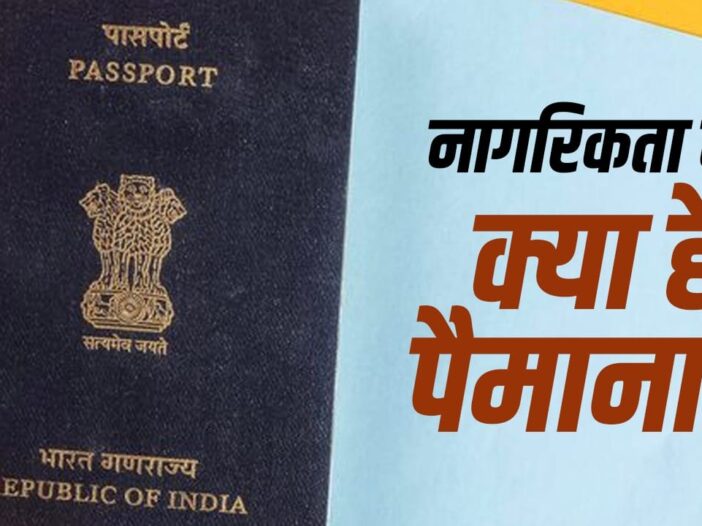
The Ministry of External Affairs had said yesterday that passport is a travel document and not a proof of citizenship. Since then there has been a debate regarding citizenship. In such a situation, let us introduce you to its details. Provisions related to citizenship are given in Part-2 (Articles 5 to 11) of the Constitution of India. The country has a system of single citizenship, which means that any person can be a citizen of India only. Neither can he hold citizenship of any state separately nor can he simultaneously hold citizenship of any other country. Citizenship in India is obtained by birth, descent and the rest on application.
According to the government, passport, Aadhaar card and voter ID are primarily identity and travel documents. These cannot be considered as final or irrefutable legal proof of citizenship. Final citizenship in India is decided only under the Citizenship Act-1955.
There are 5 ways to get Indian citizenship-
Under the Citizenship Act-1955, a person can become a citizen of India only in the following ways:
- From birth: Persons born in India on or after 26 January 1950 (as per rules as amended from time to time)
- On the basis of lineage: Persons born outside India, if either of their parents is an Indian citizen.
- From Registration: Persons of Indian origin or people married to an Indian citizen through application.
- By Naturalization/Naturalization: Foreign citizens living in India for a certain period of time (e.g. 12 years) can get citizenship by fulfilling the rules.
- By area covered: If any new territory joins India then the people there automatically become Indian citizens.
Rules for termination of citizenship
The Constitution of India does not allow dual citizenship. Citizenship can be terminated in India in these 3 ways.
- Renunciation of Citizenship: If a person voluntarily gives up his Indian citizenship.
- Termination of Citizenship: If an Indian citizen acquires the citizenship of another country, his Indian citizenship is immediately terminated by law.
- Deprivation by the government: If someone has acquired citizenship through fraud, forged documents or treason, then the central government can deprive him of citizenship.
Citizenship Amendment Rules-2026: The Union Home Ministry has notified the Citizenship (Amendment) Rules-2026. Under this, a strict ban has been imposed on minor children holding dual passports. Also, the entire process of registration and abandonment of Overseas Citizen of India has been completely digitalized.
Citizenship Amendment Act: This law provides for granting Indian citizenship through an easy process to Hindu, Sikh, Buddhist, Jain, Parsi and Christian minorities who came to India from Pakistan, Bangladesh and Afghanistan before December 2014. Its entire process is conducted digitally through the Indian Citizenship Online Portal.

Leave a Reply