Not much time has passed when women in villages used to cover their body only with saree (cotton janana dhoti). There was no custom of wearing blouse and petticoat. While grinding grains in the mill in the morning, she would become drenched in sweat and would pull down the pallu of her saree till her waist. Also she would raise her saree above her ankles. Similarly, while bathing in ponds, ponds and rivers, the pallu of her saree would remain like a thin curtain only on the upper part of the waist. He had no hesitation in changing his clothes even at public places on the banks of these ponds and rivers. Men also bathe in the same ponds, but seeing such scenes neither arouses sexual lust in anyone nor does this scene appear to be a symbol of anything untoward or shameless. Yes, if we think of that scene today, our mind will definitely become restless, but the past cannot be remembered with today’s desires and lust.
It was a matter of shame for Brahmo women to wear blouses.
Rabindranath Tagore has written in his famous novel Gora that Sanatani woman Harimohini does not like the women of Brahmo community because the women of that community wear blouses. Till recently, women used to wear unstitched clothes and make roti, this trend has been prevalent among some elite Brahmins of Eastern Uttar Pradesh. India is a hot and tropical country. There is more humidity in the atmosphere here and when the mercury rises, one feels like taking off clothes. In the old paintings of Bengal, most of the men did not wear anything except loincloth-like dhoti and women also mostly preferred to remain without blouse. In contrast, Europeans came from cold countries, so French, English, Dutch and Portuguese men and women wore clothes covering every part of the body. There is no humidity and heat in Muslim countries, hence there was a custom of wearing a lot of clothes.
Nudity is not a sign of sluttiness
Nudity was never considered vulgar in India. Every woman here likes to be called well-built. Here this is the metaphor of female beauty. That is, a woman is one who can enhance her appearance. That is why make-up has become more popular among Indian women. Such makeup which has elegance but is not vulgar. It is said in the villages, ‘Pahari-odhi Mehriya, Lipi-puti Dehariya’! That means a woman should wear jewelery and good silk clothes and similarly the house should be kept clean. There has never been any stigma regarding sex in India. Especially in the plains of Ganga-Yamuna in the North and in most of the temples of Eastern India, scenes of male-female relationships are seen in the sculpting of idols of Gods and Goddesses. A large number of such statues were made in the temples built by the Chandela kings around the tenth century.
The standards of morality are different in every era and every society.
The standards of morality are different in every era and society of that time. The things which were common in India then are now the colors of European and American culture. Whereas Europe kept the morality of the Victorian era as its ideal for a long time. Even though there was a lot of immorality secretly prevalent in this closed society for women, the elite class there kept women covered with veil. No poor man would even dare to go near such women. The same moral standards remained in the twentieth century also. In 1928, DH Lawrence’s novel Lady Chatterley’s Lover exposed the layers of British society. In this, a physical relationship develops between Connie, an aristocratic lady, and Oliver Mellers, a laborer in her farm house, which was taboo in the European society of that time. On the contrary, in India, Dharma, Artha, Kama and Moksha are considered as Siddhi.
attempt to cover dancing girl
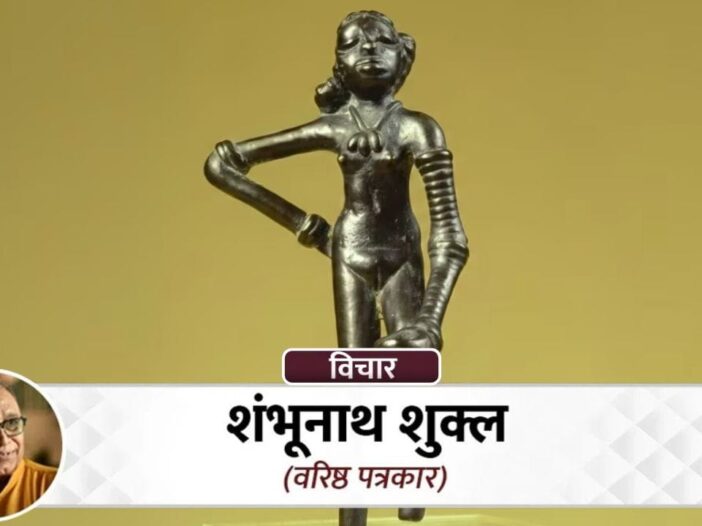
But now how much the thinking of Indian society has changed. Among the remains found in Mohenjodaro and Harappa, a statue of a dancer was found, who is completely naked. In the course of development of human civilization, this civilization, which is said to be around 4000 BC, is included in the NCERT syllabus. It has been taught in junior classes for many decades. Also, the photo of this dancer, who has been called Dancing Girl, was also compiled in books. I have also studied about this civilization in social subjects till eighth grade and so have my children. Not only this, people of older generation than me have also studied the same course. But no one felt any nudity in this dancing girl. Nor did we have any bad feelings about this statue in our childhood mind. Now the National Council of Educational Research and Training (NCERT) has tried to dress this statue considering it obscene.
You will destroy the reality of archaeology!
This statue of a dancing girl was found by Ernest Mackay when he was searching for the remains of the Indus Valley Civilization. Ernest Mackay was a British archaeologist and he found this statue 100 years ago. Under the National Education Policy, the book named Madhurima prepared by the selectors for class 9th, has this statue printed in the first chapter History of Arts, which has been blurred. The protruding parts of the chest and genitals of the idol have been removed. The idol which till date has not aroused any lust among the teenagers but the scholars of NCERT felt the nudity in it. Even before today, this idol was included in the curriculum but no attempt was made to cover any particular part of this idol. Now the real form of this idol has been hidden, then this idol is no longer of archaeological importance.
obscenity is in our eyes
The question arises that if this trend is not stopped then tomorrow some people will say that the nude statues engraved on the walls of Konark and Khajuraho should be removed. Such stories of Puranas and epics should be left out, after reading which the sensuality of such scholars gets aroused. In this context, Karl Marx’s companion and prominent scholar of the 19th century, Frederick Engels, in his famous book The Origin of the Family, Private Property and the State, has said on the naked and erotic looking depictions of women described in Greek mythology that if we consider that society to be devoid of sexual shame, then it means that we ourselves are immoral, obscene and lascivious. Moral standards are decided according to every time and society. People of that time did not realize what is immoral today. Therefore morality and obscenity are time relative.
Tomorrow we will find immorality in our ancestors.
Famous historian Vishwanath Kashinath Rajwade has written in the history of Indian marriage institution, human society continuously develops. Therefore look at the past from the perspective of the past. If we study without time, we will feel ashamed of our ancestors because what was moral yesterday is immoral today. If we look at the sculptures carved in the temples of Khajuraho from the point of view of art, we will be amazed, but if we look at the sculptures of these temples from the point of view of lust, we will see obscenity in them. Therefore, we should not keep our perspective narrow while reading our history. These sculptures are heritage, which will tell the artistic vision of our ancestors for ages. Finding obscenity in these is a very narrow view. So let history remain history.

Leave a Reply