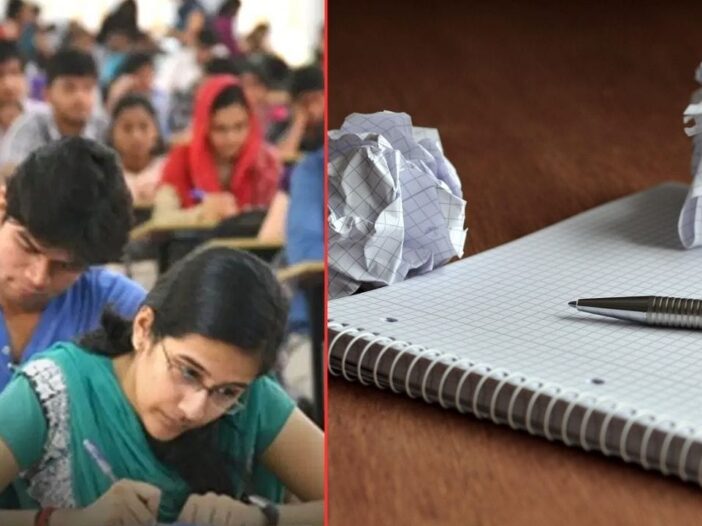
In today’s era, when the decision-making process is being decided regarding incidents like paper leak, there is a question in the minds of the youth of a state like Uttar Pradesh that where did the roots of copying culture begin and during which regime did it flourish and become such a big vine. The matter of Uttar Pradesh is also relevant because most of the youth of this state see their future in examinations and when their talent does not get a proper platform, they get frustrated. The future of the youth of the state is decided by the atmosphere of the examination hall and the intentions of the recruitment board.
In the last three decades, this state has seen two completely opposite situations on this front. a time Samajwadi Party We also saw the era of the governments when copying had almost institutional patronage and nepotism was prevalent in recruitments. The second phase is during the tenure of Chief Minister Yogi Adityanath, when the roots of the copying mafia were attacked by making the most stringent law of the country. The point of comparison between these two periods is because this is a question related to the breathing of millions of youth, whose future life depends on the result of an examination.
When copying ordinance came into force in Uttar Pradesh
The character of any government is determined by its decisions. Before we start talking, let’s go back a bit. Let’s start from 1992 when the Cheating Ordinance was implemented in Uttar Pradesh, the objective of which was to completely curb cheating in examinations. But as soon as Mulayam Singh Yadav’s government came to power, this law was made practically ineffective. Along with this, the policy of self-centre was maintained, under which students could take the examination in their own school. This policy appears to be just an administrative decision, but its long-term consequences proved to be extremely fatal. Under the guise of this policy, a parallel system was set up across the state, which later people came to know as copy mafia.
The direct effect of this relaxation was also visible on the examination results. In the year 2004, intermediate exam results suddenly reached unprecedented heights, which seemed to be the result of systemic laxity rather than any general educational progress. The saddest aspect of this was that the students who had worked hard for years and wanted to move ahead on the basis of merit, were left behind in this crowd, while the pockets of the mafia system continued to be filled. This hollowness in the foundation of education continued to harm the state for years to come.

Brij Lal (Rajya Sabha MP and former Director General of Police, Uttar Pradesh)
Problem and depth between 2012 and 2017
When the Samajwadi Party came to power under the leadership of Akhilesh Yadav, it was expected that some meaningful decisions would be taken regarding recruitment, but between 2012 and 2017, instead of the situation improving, the problem deepened. During this period, the dignity of competitive examinations was repeatedly attacked. There is hardly any big recruitment board of the state left which is not accused of rigging or paper leak. The incident of medical entrance examination question paper being leaked from the treasury gave a blow to the dreams of lakhs of candidates and ultimately the examination had to be cancelled.
Similarly, the question paper of the most prestigious administrative services examination of the state was also leaked through social media, after which there was no option left but to cancel the examination amid huge protests and uproar. Bribery was also exposed through a sting operation in the recruitment process for the post of Village Development Officer, in which claims of involvement of influential people associated with the ruling party came to light. Copying and paper leaks emerged as a systemic feature of that era.
Cabinet ministers themselves did recruitment in all departments.
Another noteworthy thing here is that while the recruitments in all the government departments in the state were done through the Uttar Pradesh Public Service Commission and Subordinate Services Commission, in the Akhilesh government, Cabinet Minister Azam Khan used to do all the recruitments in all his departments himself. In their departments, jobs were distributed extensively to people of particular religions. Nepotism in recruitment became the special identity of the SP era. Serious questions were also raised on an institution like Uttar Pradesh Public Service Commission, whose impartiality is considered the backbone of any democratic system. A PIL was even filed in the High Court regarding the disproportionate number of candidates belonging to a particular caste category in the selection, in which figures of huge imbalance in the selection process were presented.
Such allegations created deep resentment among the meritorious and candidates from other sections, as they began to feel that caste and political proximity had become the basis of selection rather than merit. In this series, the controversy regarding police recruitment was also no less serious. After finding evidence of large-scale fraud, political recommendations and bribery in the recruitment of thousands of constables and PAC personnel, the government had to set up an inquiry committee, whose report found serious irregularities. The case languished in the courts for years, which shows how deeply entrenched the irregularities in the recruitment process were.
Policy changes visible in Yogi government
When we look at the approach of Yogi Adityanath government after 2017, a clear policy change is visible. After coming to power, the Yogi government accepted the chaos prevailing in the examination system as a serious administrative challenge and chose the path of legal intervention to solve it. The result of this thinking was the Uttar Pradesh Public Services (Competitive Examination) Prevention of Unfair Means Act, which is commonly known as the Anti-Copying Act.
This law is counted among the most stringent provisions of the country, in which a provision of punishment up to life imprisonment and a fine of up to Rs 1 crore has been made for those found involved in paper leaking or copying. Along with this, stringent measures like confiscating the property of the examination conducting agencies found guilty and recovering the entire cost of the examination from them were also made a part of this law.
Along with this legal strictness, many concrete changes were also made at the administrative level. Sensitivity was made the basis in the selection of examination centres, CCTV surveillance was made mandatory, a multi-level system was implemented for the security of question papers and the accountability of the administrative staff was fixed on the day of the examination. The result was that in a state where paper leaking was considered the fate of almost every major examination, major competitive examinations started being conducted in a relatively smooth and well-organized manner.
Condition of both the eras of governments
Comparing the two eras, it is clear that during the SP era, cheating was given almost indirect protection by leaving the examination system loose and caste and political proximity was considered effective in recruitments, whereas in the Yogi government, efforts were made to curb this trend through legal strictness. Only when the examination and recruitment system is fair, talent gets its due in real sense. It is important for a big state like Uttar Pradesh to continue this transparency in the times to come. (These are the personal views of the author)

Leave a Reply