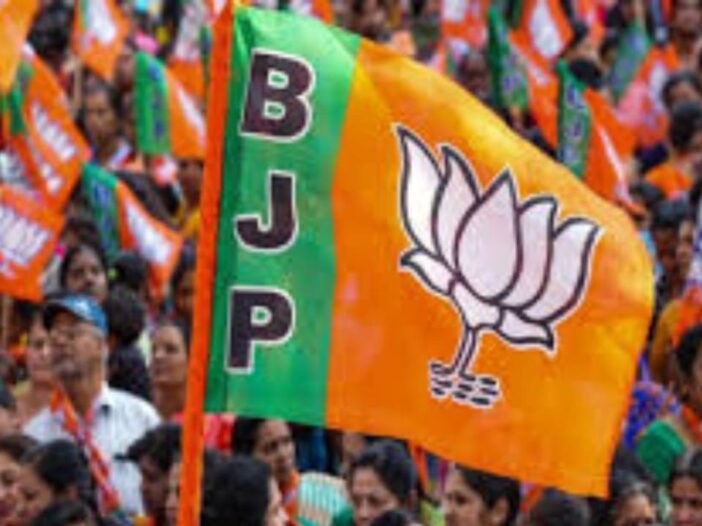
Before the upcoming monsoon session of Parliament, the National Democratic Alliance (NDA) has started giving a new dimension to its political strategy by keeping North-East India at the centre. The effect of BJP’s subtle strategy of influencing each MP is now visible. Due to this, while the NDA clan seems to be getting stronger, the discussion about the limited influence of the opposition and some regional parties has intensified.
NDA is already in control of 16 out of 25 Lok Sabha seats in the North-East. Now BJP is eyeing those regional parties which are not formally part of any alliance. Mizoram’s ruling party Zoram People’s Movement (ZPM) has emerged as the latest example of this. The party’s newly elected Rajya Sabha MP Laltaluangkima has announced to provide issue-based support to the NDA government in Parliament. The party also has one MP in the Lok Sabha.
Political Arithmetic of North Eastern Region
In such a situation, despite being out of the formal alliance, ZPM’s stance is being considered as a sign of numerical advantage for the government in both the houses. Experts on the issue say that BJP is also eyeing VPP, another ally of Congress in the North-East.
Out of total 25 seats in the North-Eastern region, NDA has 16 seats while the opposition including Congress has 9 seats. Out of 16 NDA seats, BJP has 13 MPs, AGP has 1, UPPL has 1, SKM has 1, while if we talk about opposition parties, Congress has maximum 7 MPs, VPP has 1 and ZPM has 1 MP.
‘5 surefire models’ to increase numbers
BJP’s strategy is not limited to just winning the elections, but to make its numerical strength within the House ‘impenetrable’. For this, the party is working on five different strategies (models) simultaneously. First, direct defection which involves direct inclusion of opposition MPs into BJP. Second, the strategy of resignation i.e. making the seats vacant by getting the opposition Rajya Sabha MPs to resign.
The third option is ally promotion in which opposition leaders have to be included in the allies of NDA. The fourth option is to cultivate regional equations, that is, to form new alliances through small and neutral parties. Fifth, to give recognition to the rebel groups, in which the different groups have to be given legal recognition by dividing the opposition parties.
NDA’s internal structure changed, BJP strengthened
This strategy has not only affected the opposition but also the internal balance of power in the NDA. At the time of general election results, BJP had 240 seats. Then Chandrababu Naidu’s TDP was at second position with 16 MPs and Nitish Kumar’s JDU was at third position with 12 MPs. But this internal ranking of NDA has now completely changed.
A large group of 20 MPs who broke away from Trinamool Congress (TMC) joined NDA. Due to this, Tripura’s ‘Nationalist Citizens Party of India’ suddenly emerged as the second largest force within the NDA and TDP came at the third position.
In Maharashtra, 6 MPs of Uddhav Thackeray’s Shiv Sena switched sides and joined Shiv Sena led by Chief Minister Eknath Shinde. With this defection, the number of MPs of Shinde group increased to 13, due to which they defeated JDU also. JDU, which was once the third largest force in NDA, has now slipped to fifth position.
Another story of disunity in Maharashtra!
The same story can be repeated in another party in Maharashtra itself. Even though there are no reports of a split in the NCP (Sharad Pawar faction), sources associated with BJP claim that in the coming days, some MPs from the NCP (Sharad Pawar) camp may also support the NDA from outside. BJP is avoiding saying anything openly on this issue, but it definitely seems to be indicating that in the upcoming Parliament session, many opposition parties may be seen splitting and standing in the NDA’s camp.
With the support of new small parties, factions that broke away from the opposition and issue-based support, the NDA is becoming self-reliant on the basis of its numerical strength. The ultimate goal of BJP is now not just to maintain a simple majority, but through strategic manipulations to get closer to the two-thirds (2/3) majority figure in both the Houses of Parliament.

Leave a Reply