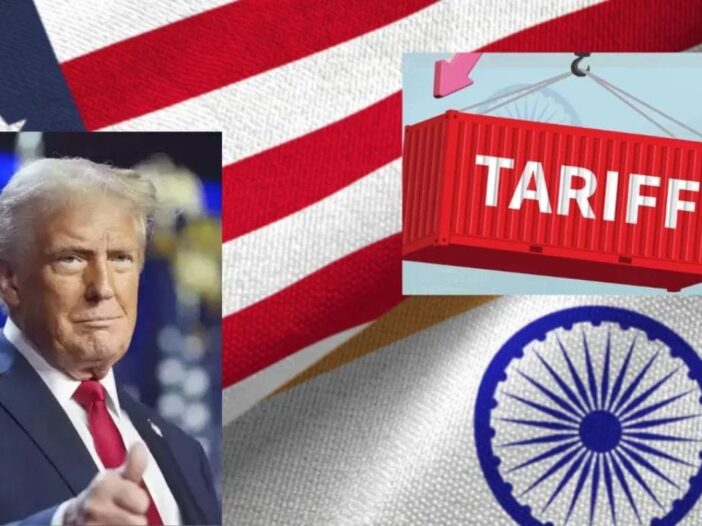
Donald Trump administration has reduced the additional tariff on most goods going from India to America from 12.5% to 10%. This will provide some relief to Indian exporters and India can get an edge in trade compared to many competing countries. However, the cost of Indian goods in the American market will still be higher than before.
The new tariff regime came into effect immediately after the temporary Section 122 charges ended on July 24. This will apply to about 70% of India’s exports to America. According to the report, India has recently tightened rules on the import of goods made with forced labour. Also, after talks between New Delhi and Washington regarding labor standards, America decided to reduce the tariff.
Why did India get lower tariffs?
This decision has been taken under America’s Section 301 investigation. Under this law, America can impose additional duty on goods coming from those countries, which in its view are related to products made with forced labor. When the proposal came in June, India was placed in the group with 12.5% tariff.
But according to Indian officials, the US reduced the tariffs for India to 10% after positive talks with the US on labor standards and India’s decision to ban the import of products made with forced labour.
According to the US Trade Representative (USTR), the 10% tariff will apply to countries that have already banned the import of goods made with forced labor, have pledged to do so, or have taken effective steps to prevent such imports.
Apart from India, 10% tariff will also be applicable on 16 countries including Bangladesh, Pakistan, Canada and United Kingdom, while 12.5% duty will be imposed on many other countries under investigation.
What will be the impact on Indian exporters?
The impact of this decision will be different on different sectors. According to Global Trade Research Initiative (GTRI), 25% or 50% additional tariff will be applicable on steel, aluminium, copper, auto components and some other products, which are already under Section 232. This accounts for about 8% of India’s total exports.
Only normal Most Favored Nation (MFN) tariff will be applicable on some selected products. The biggest impact will be on those products which constitute about 70% of India’s exports to America. These include engineering goods, machinery, chemicals, plastics, leather products, gems and jewellery, furniture and many other manufacturing products. Now Section 301 tariff of 10% will be imposed on these, in addition to the normal MFN duty.
However, GTRI said India has not received the textile and garments tariff-rate quota exemption given to Bangladesh, Cambodia, Indonesia and Malaysia on exports of certain products made from US cotton and fiber like those countries.
What benefit will India get?
Trade experts believe that this decision does not give complete relief to India, but it definitely gives an edge in competition. According to Manoj Mishra, partner, Grant Thornton Bharat, India has now come into the group with 10% tariff at par with countries like Bangladesh, Sri Lanka, Malaysia, Indonesia and Pakistan. At the same time, effective tariff on some products of Japan, South Korea, Switzerland, Vietnam, Thailand, Singapore and European Union can be up to 12.5%.
He says that this can strengthen India’s competitive position in sectors like engineering goods, auto components, electronics, specialty chemicals, pharmaceuticals, medical devices and textiles. However, GTRI founder Ajay Srivastava says that America has not presented any evidence to prove that India imports products made with forced labour. He believes that this new tariff appears to be more a part of the Trump administration’s strategy to continue its comprehensive tariff policy after the temporary Section 122 tariffs end.
He also warned that in the future, additional tariffs could be imposed on industrial products based on America’s second Section 301 investigation, which is related to Excess Manufacturing Capacity. Apart from this, the possibility of imposing separate country-specific duties on India on the basis of geopolitical issues like buying oil from Russia cannot be ruled out.

Leave a Reply