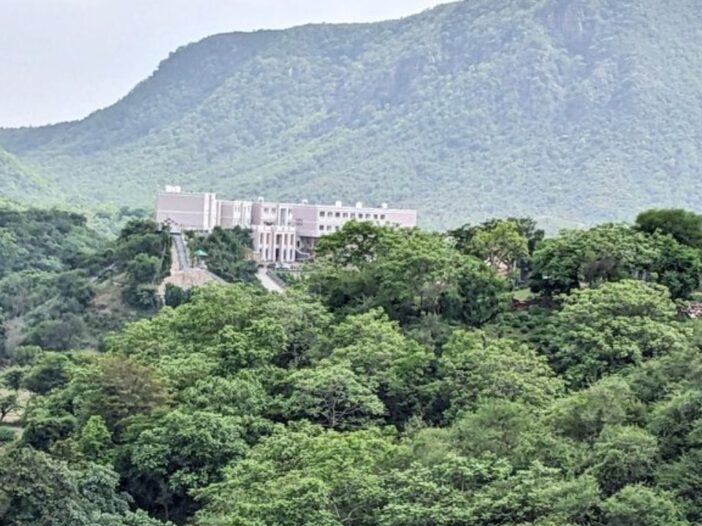
#SaveAravalli movement is trending on social media. After the Supreme Court’s acceptance of the Environment Ministry’s recommendation regarding the Aravalli Mountains, resentment is being seen among the common people and environment lovers. Demonstrations are also being held by many environmental protectionists regarding this. Environmental activists on Saturday expressed their displeasure over the new definition based on the height of the Aravali hills of Gurugram, Rajasthan and Udaipur.
Environmental activists protested against this and said that Aravalli is the oldest mountain range of the country. The new change could pose a big threat to the ecological balance of this range. In Gurugram, environmental activists, along with local people, gathered at the house of Minister Rao Narbir Singh and peacefully protested against this decision.
The protesters present at the spot were holding banners and placards in their hands. Slogans like ‘Save Aravali, Save Future’ and ‘No Aravali, no life’ were echoing there. Lawyers in Udaipur, Rajasthan also protested against this.
What is in the new definition?
The Supreme Court accepted the recommendations of a panel of the Union Environment Ministry on the definition of the Aravalli hills for the purpose of stopping mining. The new definition states that any part of land which is 100 meters or more above the local altitude will be considered part of the Aravalli Hills along with its slopes and surrounding land. That means land higher than 100 meters will not be considered.
Air quality will also be affected
What the panel did not mention here was that as per the new definition, by definition, more than 90% of the Aravali Hills would no longer be considered Aravali. That means 90 percent of Aravali is at a height of less than 100 meters. It is possible that after this definition this place will potentially be opened up for mining and construction. Doing so can indeed have serious environmental consequences. This also includes the air quality in the National Capital Region.
According to Forest Survey of India (FSI), the Aravalli hills are spread across 15 districts of Rajasthan. Here, 12,081 areas are 20 meters or more high, of these only 1,048, i.e. only 8.7%, are 100 meters or more high. The 20 meter height limit is essential for the hill to act as a wind barrier.

Leave a Reply