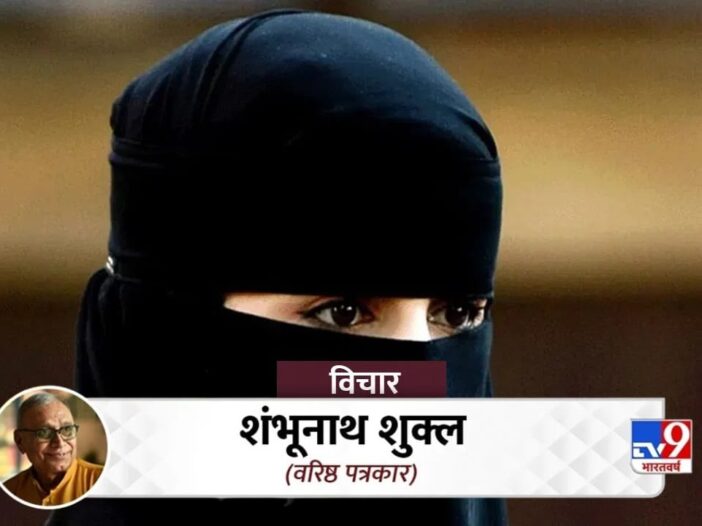
The video of Bihar Chief Minister Nitish Kumar pulling the niqab of Muslim female AYUSH doctor Nusrat is going viral on social media. It cannot be said that it is right to lift the burqa, veil or hijab of any mature woman. Certainly, the reason for a serious politician like Nitish Kumar pulling off a woman’s burqa would not have been to humiliate or expose her. Still, removing the burqa from a woman cannot be called right. A politician holding such a high position had to maintain the woman’s dignity and her modesty. Burqa, veil and hijab are symbols of a woman’s identity and her privacy in the society. If she veils, her veil should be respected. Just like a man cannot search a woman, it is a crime under the law. Even if that man is her father, brother, son or even her husband. This will be considered as a violation of the privacy of that woman.
At times of such controversy, I remember a Muslim woman, Rubin. I met that woman named Rubin in Trivandrum Rajdhani Express. A few months before Covid, I was going to Udupi in AC first class of Trivandrum Rajdhani Express. A friend of mine was also with me. As soon as the train moved from Nizamuddin railway station, a Muslim couple came to our cabin. Those people were coming from Saudi Arabia. The husband was thin and had a beard on his face. While the wife was looking well fed and at home, she had wrapped the burqa around her body in such a way that only her two eyes were visible. His two-berth coupe was second but someone else was sleeping there. So they came to our four-berth coupe.
Confidence behind the burqa
We had two berths vacant. The woman in the burqa told that her husband and wife, who were lying in their compartment, had said that they would get down to Kota, so she came here. She sat next to me on my berth and my husband sat on a friend’s berth. There was a cute one year old baby in the woman’s lap. After some hesitation the woman asked us where we were going? She was happy when we told her about Udupi and said, we will get down at Mangalore, the next station after Udupi. I asked where do you live from? The woman told that I am Mangalorean and he is from Chennai. Then he opened the channel for conversation. She started telling, I have three sisters. While these two brothers. The brother-in-law is in a government job and the sister-in-law teaches in a college. They all live in Chennai. Told about ourselves that we are from Kundapur near Udupi. Even though she was wearing a burqa, she had no hesitation in talking to me.
Mother-in-law and sister-in-law do not wear burqa
I asked how many years have you been in Saudi? She said- Since three years. Then you must know Saudi dialect i.e. Arabic? On my question she said – I just understand a little. Then why not learn? When I asked further, his answer was that I like Hindustani dialect and India. I won’t even learn Arabic. She told that burqa is mandatory in Saudi and women there cannot leave the house alone. I said, that’s where you learned to wear this kind of burqa? She said no, our father is strict about burqa. Whereas in the in-laws house neither the mother-in-law nor the sister-in-law were wearing clothes. Saying this he removed the mask from his face. Wheatish complexion and pointed nose! She was a beautiful woman. He told that his name is Rubin. Husband’s name is Abdullah. The one year old child in her lap was named Fatima by her husband but Rubin added Ayaan to it.
Why didn’t you guys bring your wives?
Rubin also told that Ayaan was added so that later on, if the child asks her mother why she kept my old name Fatima, then she will tell her that Ayaan is a modern name. She said, educated Muslims, Hindus and Christians also keep this name. Then he asked our names. Hearing Shukla in front of her name, she started asking whether the Shenoys on our side have become Shuklas in UP! I liked his explanation. Why didn’t you guys bring your wives? Suddenly he asked a explosive question. He had a lot of difficulty in explaining why we did not bring our wives. He also asked how many children do we have? I told that I have three daughters and they also have children. Asked for photo of children but I did not have any photo.
In the morning she came in Karnataka saree
He had no shortage of things. By then Kota arrived and both the husband and wife went to their G cabin and we were left alone in F but while leaving she said that whenever you guys are bored, come to our cabin. If I get bored, I will come to you guys. In the evening she brought the child. Now she was not wearing burqa. She was wearing a saree, exactly in Karnataka style. She said- I like saree but have to wear burqa. He said that it is good for you guys. There is no ban on burqa for Muslim women there. Wear whatever you feel like. But there is not so much openness in our South. I said that most of the Muslims in North India were Hindus earlier, later they converted and became Muslims. Therefore, they are similar to Hindus in their dress, customs and caste-community.
The girl passed out after eating pedas!
After Kota, our Trivandrum Express train stopped at Vadodara. It was quarter to 11 at night. At Vadodara station, another friend of ours came to our cabin with several packets of Gujarati namkeen and heavily pounded khoya pedas. The train stops there for ten minutes, till then he stayed with us. The next morning after breakfast, Rubin came to our cabin with her daughter Fatima Ayaan. Today she was wearing a burqa but her face and head were uncovered. He told that since there are only two of us in his compartment, how long will he have to see the faces of his mom and dad? She kept crying the whole night. When I started pressing his daddy’s feet, he started crying. We fed pedas to the girl and also gave them to her. After eating the pedas, the girl also crossed paths with us and came into our lap.
Rubin also found the peda very tasty and she took two for her husband also. She kept talking about Saudi Arabia with enthusiasm. He told us that you people should come there but only with a business visa because it is very difficult to get a tourist visa there. Only those performing Haj can go there. I asked that this girl must have been born in Saudi? She said- No, when this was going to happen, I had come to India. The delivery took place at her maternal home. Anyway, I do not want our daughter to be called a child of Saudi. He also told that if we give about one crore rupees there, we can get Saudi green card, but we will not get it because if we give so much money, then we cannot get the civil facilities there. Saudi is not a good country. There is a lot of discrimination with us. But they are lying there for the sake of their stomach.
Rubin suggested us to go to Sringeri
Now our train was running on the route of Konkan Railway. The train had crossed Ratnagiri. On both sides there were Sahyadri hills, forests, waterfalls and gushing rivers. Looking at them, Rubin said – In Saudi, we crave this greenery. The love for his land and his people was clearly visible in his eyes. Rubin was a follower of the sect of Islam but there was no fanaticism in her. He loved greenery, he loved music and also singing. He loved India and also Hindu religious customs. He repeatedly told us that when you go to Agumbe, go to Sharda Peeth in Sringeri and also meet Shankaracharya. He told that this monastery was built by Adi Shankaracharya, hence you all must visit.
Sad Rubin expressed his concern
Then she left. In the evening Rubin came again and told that they were also getting down at Udupi because the train was very late. He has called his parents from Kundapur. She had brought date biscuits with her. He said eat these, they are from Saudi. The biscuits were delicious. He told us that it is getting night, you guys should stay at Udupi because the road to Agumbe is a ghat (ascent and descent). On top of that, a forest full of cobras and leeches. We agreed. At around eight o’clock in the night, while opening the door of our cabin, he said – pack your luggage quickly, the train will stop here for a total of two minutes. By now it had been 33 hours traveling in the train. We collected the luggage and called the attendant to get the luggage unloaded.
Khuda Hafiz Rubin
Two-three women in burqa were standing below and also an elderly man with a beard. A boy was also with him. I told my friend to wait now. At least have a boy-boy relationship with Rubin and her daughter Fatima Ayaan. Rubin came down again, covering her entire body with a burqa. Now only two eyes were shining from her burqa. She was holding Ayaan in her lap. When we called Ayaan a boy, Rubin said – I introduced him to Allah-Hafiz and that old man who was his father, but that old man, who was busy in paying attention to his son-in-law who had come from abroad, called us God-Hafiz! Just waved his hand when asked. After Rubin left, I came out of the station with a sad heart and took a taxi and went towards Agumbe, 28 km away from there.
Burqa can also be someone’s identity
Rubin made one thing clear that people who consider the veil as a symbol of backwardness do not understand the self-confidence of the woman behind the veil. In Islam, the need for purdah has been explained to women but it has not been said to be inevitable. Women in many Muslim countries of the world also do not wear burqa or hijab. Hindu women are almost free from the veil. But all this is related to the personal wishes of the woman. It is not right to pull the burqa of a Muslim woman or force a Hindu woman to wear her veil. Chief Minister Nitish Kumar may have fatherly intentions but his pulling off the burqa cannot be justified. A woman can maintain self-confidence even while wearing a burqa. Burqa is her identity, it should be respected.

Leave a Reply