Earthquake tremors were felt again today in Narsingdi area of Bangladesh’s capital Dhaka. The epicenter of this 3.6 magnitude earthquake was 28 km north-east of Ghorashal in Narsingdi. Before this, four earthquakes have occurred in Narsingdi. On November 21, an earthquake of 5.7 magnitude hit many parts of Bangladesh including Dhaka, in which 10 people were killed.
Within 32 hours, three more small earthquakes of magnitude 3.3, 3.7 and 4.3 occurred. The frequent tremors show that earthquakes are now happening more within Bangladesh and not just due to movements coming from India or Myanmar. Let us know what is the reason for the continuous earthquakes in Bangladesh.
Bangladesh exists between three plates
Bangladesh lies between three tectonic plates: the Indian Plate, the Eurasian Plate and the Burma Microplate. Therefore, there is constant pressure below the ground. According to scientists, many faults in the country are slipping a few millimeters every year, which increases stress and creates the possibility of earthquakes.
The eastern part of the country is near the Arakan Subduction Zone, where the Indian Plate sinks beneath the Burma Plate. This area can produce very strong and large earthquakes.
There are also many active faults within Bangladesh
- Dauki Fault: Near Sylhet, Mymensingh and Sunamganj
- Madhupur Fault: around Dhaka and Tangail
- Chittagong-Myanmar Border Fault: Chittagong and surrounding coastal areas
When these internal faults move, shallow earthquakes occur. These cause more damage because the energy comes directly to the surface.
The reason for most of the tremors in Dhaka?
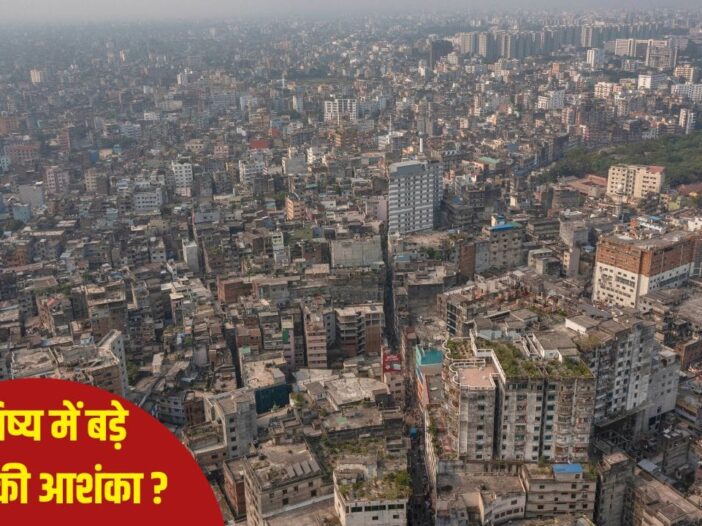
The situation in Dhaka is worse because the soil of the city is very soft, loose and full of water. When earthquake waves pass through this soil, they are felt more strongly. This is called site amplification. Therefore even a small earthquake becomes dangerous in Dhaka. Due to lack of groundwater, the soil has become weak and at many places the soil has also become marshy.
Disturbances in Dhaka’s construction plan
In the recent earthquake, cracks were seen in many tall buildings of Dhaka. More than 50 buildings were damaged. The Dhaka Metro Rail was built to withstand earthquakes of up to magnitude 7, but cracks were found in many stations after the tremors. This proves that there is a difference between the rules made on paper and the real situation.
Fear of major earthquake in future
Experts say that in small earthquakes the stress is slightly less, but sometimes this stress can also increase towards a big fault. Bangladesh is near a large locked fault (Indo-Burma Subduction Zone), where a very large earthquake may occur in the future.
According to Bangladesh Meteorological Department (BMD) officials, if the recent tremor had continued for 5 to 7 seconds more, many buildings in Dhaka could have collapsed. Surveys show that in an earthquake of 7.5 magnitude, 72 thousand buildings can collapse and 1.5 lakh can be seriously damaged.

Leave a Reply