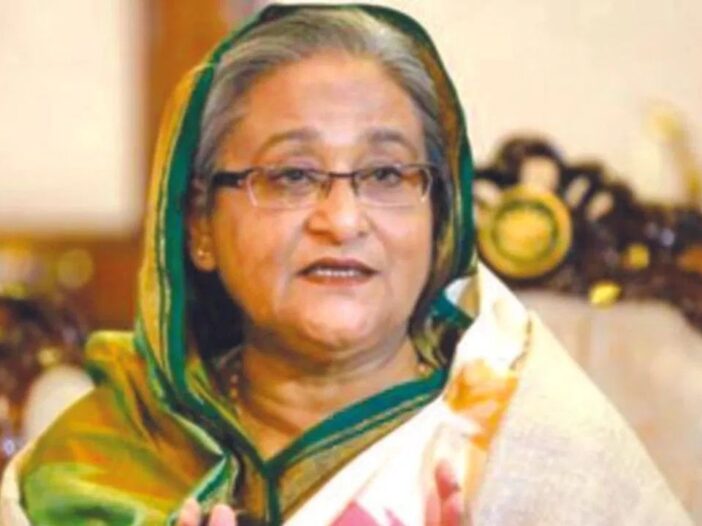
New difficulties have arisen for former Bangladesh PM Sheikh Hasina. There was Bangladesh Rifles (BDR) rebellion in the country 16 years ago. Many senior military officers were murdered in this. Now a commission was formed to investigate this rebellion that took place 16 years ago. The commission has claimed that Sheikh Hasina herself had ordered this rebellion.
According to AFP news agency, the panel has also accused India of playing a role in weakening the Bangladesh Army. The reports released on Sunday increase pressure on Sheikh Hasina, who already faces the death penalty on charges of “crimes against humanity” related to her government’s crackdown on protests last year.
What was the military rebellion?
This commission, formed by the Mohammad Yunus-led interim government after Hasina was removed from power last year, was tasked with re-investigating the Bangladesh Rifles (BDR) insurgency. This rebellion broke out in Dhaka and spread across the country.
In this two-day rebellion in 2009, 74 people were killed, including top military officers. This incident happened just weeks after Sheikh Hasina returned to power.
Commission leveled allegations against Hasina
The head of the commission, A.L.M. Fazlur Rehman alleged that the then Awami League government was directly involved in this rebellion. He described former MP Fazle Noor Tapas as the “chief coordinator” and claimed that Tapas acted on the instructions of Sheikh Hasina, who had given the “green signal” to carry out these killings.
The report prepared by Rahman also alleged the involvement of an unknown foreign power. “The investigation has found strong evidence of the involvement of a foreign power,” the report said.
Name of India also taken
According to local media bdnews24, Rahman said, “The aim of this conspiracy was to weaken this force (BDR/Army) and destabilize Bangladesh. At that time India wanted to create instability, while the then government wanted to increase its power.”
He said in the press conference, “After the BDR massacre, the government wanted to prolong its rule and the neighboring country (India) wanted to destabilize Bangladesh.” When asked which neighboring country he was referring to, Rehman said it was India, where Hasina and many of her party leaders have taken refuge.
Rehman claimed, “At that time, about 921 Indians had come to the country. Of them, 67 have not been traced till date.” He called it proof of India’s alleged involvement. India has not responded to these allegations. Sheikh Hasina has taken refuge in India after the major protests of July-August 2024. Since then there is tension in the relations between Bangladesh and India.
What did Yunus say on the report?
Meanwhile, Yunus welcomed the commission’s report. He said, “The truth has finally come out through the commission’s report.” Previous investigations during Hasina’s government had blamed the mutiny on long-standing resentment among soldiers over pay and treatment. However, her political opponents have long claimed that Hasina used the rebellion to tighten control over the military.
Demand to hand over Sheikh Hasina to India
Along with the insurgency-related charges, Bangladesh on Sunday also reiterated its hope that India extradite Sheikh Hasina at the earliest. Speaking to diplomatic journalists in Dhaka, Adviser on Foreign Affairs Mohammad Tauheed Hussain said the issue should not define relations with India, but added that Hasina’s return is a priority for the government.
He said, “I believe that our bilateral relations will not get stuck on just one issue.” Yet he added that since Hasina is now a declared convict, Bangladesh “expects India to deport her soon.”
Sheikh Hasina was sentenced to death on November 17 for “crimes against humanity”. His Awami League government was ousted from power on 5 August 2024 during the July Uprising, after which he took refuge in India.

Leave a Reply